I was online last night and saw how fans were counting down in "real time" till the official release of the first trailer. As you can see from the poster, as per the first film, a "big dumb object" (to use Peter Nicholl's term) features prominently. While it's pleasing to see some evidence of continuity, there may also be a real danger of moving quickly from the sublime to the ridiculous: have a close look at the trailer below, and be sure to freeze it at around 44 seconds in. If you look to the right, very closely, you'll see a humanoid figure who resembles the enormous head in the poster. I really hope then that the Space Jockeys don't prove to be a race that resembles the silly Cenobites from the Hellraiser films (or that other similarly nattily attired villain in Dark City).
To be fair though, I don't have much to go on yet, so I should probably wait till next August before passing judgement. I'm going to be taking in some new material, not specifically related to this film, over the course of the next few days; hopefully it might inspire me to drop in here again to post something about the kind of horror I'd like to eventually see in a science fiction film.
The name of this blog and the pic of the Space Jockey are all drawn from the movie Alien (which as a kid gave me my first sense of the connections between biology and technology), so I might be expected to comment on the leaked trailer for the prequel which has been doing the rounds in the last 24 hours, and disappearing at an equally rapid rate thanks to threats from 20th Century Fox . There was still a poor quality version left on YouTube when I last checked, but I urge anyone who might be interested to instead wait for the official release (which is why I am not posting that trailer here).
The original film was very important for my personal development and I would like to be able to say more about this once Prometheus is released. All I will say for now is that my expectations are not that high for this prequel because the key to the original's success was that it was largely based on H.P. Lovecraft's maxim, "atmosphere, not action." So no need for exhaustive explanation either, which forces us to use our own imaginations instead. But how can the prequel respect this when everything so far suggests it will be attempting to explain everything. Drawing on the term used by sci fi critic Peter Nicholls, I can also say that what really fired my imagination as a youngster was the Nostromo crew encountering "a big dumb object" i.e. the Space Jockey on Acheron LV-426. This incredible sequence, the greatest I have ever seen, sticking with the terminology favored by Nicholls, Clute et al, instilled in me a "sense of wonder". This was tempered by the knowledge that the warning signal meant there was no possibility of being enchanted by the kind of "cargo cult" qualities associated with the properties of other mysterious xenoarchaeological artifacts, not least the monolith in 2001: A Space Odyssey. Unlike Dave Bowman then, there is no lebensphilosophie style personal transfiguration from crossing a threshold, given how everyone who walks around the derelict is eventually killed by the alien; starting with the necrogenesis scene (better known as the "chestburster scene"), when male crewmember Kane gives "birth" to the alien that implants itself in his body in the derelict's egg chamber (although it could be argued on the basis of the deleted scene featured on the DVD that Captain Dallas [and Brett] is forced to undergo a metamorphosis by being incorporated into the creature's life cycle; however, this is so horrible that it is probably as far from the "exalted" sense implied by transfiguration as one can imagine).
Mentioning Clute et al shows that over the years I've realized that Alien draws on certain conventions of science fiction, but this has only enhanced my appreciation of its qualities. In addition to being so prescient, as all good science fiction should be, with its theme of bio-weapons meets corporate malfeasance, I credit the film a lot for violating the formerly pristine, white environments usually favored in depictions of space travel, through its spectacular focus on body horror. And this raises another intriguing question: whose sense of horror is it really? Perceptive critics have responded by examining the racial coding of the xenomorph as black, whereas feminists are fascinated and appalled in equal measure by the film's equating of technology and reproduction. I'd recommend reading this comparable essay on John Carpenter's The Thing for more of a sense of the "body horror" that might be at stake in Alien as well (The Thing, incidentally, shares with Alien a linkage back to the xenoarchaeological themes of Lovecraft's "At the Mountains of Madness"). Eric White ties together the issues of racial/species/gender identity in relation to evolutionary theory:
Evolutionary theory has often figured in science fiction as a powerfully resonant topic, a privileged point of departure for the staging of a variety of highly charged concerns and conflicts. In some narratives, the positing of a shared kinship between humans and other animals provokes revulsion at the implied refusal of any claim to human preeminence in the greater scheme of things. But the erosion of "Man" as a putatively ontological category and the prospect, moreover, of reality as a Joycean "chaosmos" of perpetual change or metamorphosis can also be depicted affirmatively. The theoretical elaboration of an evolutionary universe need not exclusively elicit horror and anguish. It may also prompt the speculative imagination to extrapolate a future for what might be dubbed "the post-human body becoming." In this essay I’m going to examine a number of exemplary responses in science fiction to the advent of modern evolutionary thought. Discussion will focus in particular on John Carpenter’s 1982 version of The Thing and Octavia Butler’s more recent XENOGENESIS trilogy as evolutionist narratives offering respectively traumatized and affirmative perspectives on a world in which, as Heraclitus long ago put it, "everything flows and nothing abides, everything gives way and nothing stays fixed."
It isn't clear to me though whether the author's enthusiasms are really stopping short of the kind of Deleuzian excesses that we saw Steve Fuller recently criticizing in the interview I posted on this blog. Sci fi then can clearly be mobilized either in support of, or to express horror at, the kind of projects we humans strive for in the future. It can be worthwhile taking the time to seriously consider its implications.
Well, I guess until the new film comes out, I'll continue when I have moments to myself to take a relaxing walk, plotting my own little psychogeographies as I go by listening to and dreaming about certain music that for me evoke the scene of the crew approaching the derelict (such as the opening track of The Tower by Mordant Music). And speaking of artifacts, don't masks have a slightly xenoarchaeological quality about them as well, in that they too can function as gateways/portals in rituals and fantasy literature that can open the wearer up to forces with the power to transform personal identity? But as I've already hinted in my reference to Kane, to describe the "facehugger" in this way would be a bit of a stretch; although it was probably inevitable that someone would make this anyway (which is clever and humorous in its own way, to be sure).
These have just been a few fairly spontaneous musings inspired by my viewing of the new Prometheus trailer and then looking for a further excuse to avoid going back to work. Not long ago, for the very same reasons, I threw together the following little piece, which combines a couple of motifs from Alien and Lovecraft. It doesn't really look too bad on a big monitor. I thought the storyline could be something like this:
"After surveying the outer systems for many long years, a team finally made it back to Earth to find out why they had lost all contact. This pic was taken in China, but the team discovered identical statues in every major city around the world. The cities had all been reduced to smoking ruins and the atmosphere was no longer breathable. It seems Earth's fate had something to do with the mysterious Cthulhu cult which had spread during the team's absence...."
I've really been enjoying listening to Sleep Research Facility's album Nostromo a lot lately which--as you might have guessed--is inspired by the film Alien. As Kevin Doherty has revealed in an interview:
Those that have heard of SRF will probably know you through the Nostromo CD that was released by Cold Spring Records a while ago. This was, as the name suggests, promoted as a soundtrack prelude to the Alien film. Why did you choose to follow such a concept? Does Alien, or the imagery in the film, have any special place for you? KD: “Soundtrack prelude to the Alien film”, that's a terrific description. Yeah, "Alien" is my favourite film (I'm big into films and I really like good incidental music) and as a quiet haunting environment the ship "Nostromo", on which the story takes place, is second to none. Also, it seems to me to be really highlighted during the film's first moments – those introductory slow panning shots, there's a strange sense of abandonment so the whole project is kind of inspired by this opening sequence of scenes. Also one can't help but always associate deep space travel with some kind of hyper-sleep or suspended animation, so that theme is almost automatically present as well, though that wasn't really a deciding factor in choosing the subject matter (it's really about the ship, not the people sleeping in it). I suppose I tried to create an aural equivalent of these sensations one might feel, all alone exploring this vast dark place, cut off from everything and everyone -- nothing (apparently) happening, just you and the environment, no distraction, no conversation, not really overtly nightmarish but still curiously tense in some otherworldly and dreamlike way -- something lurks in the shadows but it never jumps right out to scare you, it's maybe a bit like sneaking around in the dead of night when everyone else is asleep, which can be fun and at the same time maybe a bit un-nerving in a compelling sort of way".
It's very hard to capture the kind of structure of feeling I attempted to evoke in my previous posting concerning the work of Darren Jorgensen, which I detect again listening to Nostromo. But how could it be otherwise, when you are dealing with something on the edges of semantic availability? No doubt there will be proponents of so-called "dark vitalism" out there who will soon turn their attention in earnest to this style of ambient music, leading to all sorts of imaginings along the lines perhaps of Deleuze and Guattari's invoking of how Lovecraft's... (should take me five minutes to try to plug into this style of thinking...first I have to create an appropriate search string; wait! I've found something already, ok, let's go then) (ahem!) ...stories become most abstract when he attempts to encounter the plane through the exquisitely minimal, imperceptible haecceities...but of course the plane cannot be encountered. Things emerge through the plane, but the plane does not exist unto itself. Deleuze and Guattari say of music that "there is a transcendent compositional principle that is not of the nature of sound, that is not 'audible' by itself or for itself. This opens the way for all possible interpretations" (TP266). The horror of Lovecraft's cosmos comes because "it" is not. Through access to the different organisational principles of the cosmos, his protagonists are faced with the truly voluminous and thus mind-shattering infinity of variations and immanent-interpretations (not reflections) of states of perception.
This would be music as a liberating practice that opens gates to what Patricia MacCormack (who I have been borrowing from here) describes as "an infinite territory beyond representation, signification, and perception itself". Could it be that Matt Howarth is attempting a similar gesture in his stories about isolated characters who attain "enriched visions" through personal transfiguration? Howarth is a particularly interesting figure in this context I think because he has long incorporated electronic musicians as characters in his works, with Enriched Visions paying tribute to onetime Lustmord collaborator, and outstanding ambient composer in his own right, Robert Rich. Indeed, the book features a dialog between the two about the parallels between the stories and Rich's own compositions. A dark vitalist might go further by quoting MacCormack's observation to the effect "that these relations force alternate modes of perception without laying new structures of apprehension, finally leading to the function of art as catalysing becomings in the reader/listener by demanding alternate perceptions of relation with any and all entities".
And so to an overview of the stories in question:
"A collection of short science fiction and surreal stories by Matt Howarth based on the compositions of ambient pioneer Robert Rich. Embark on a series of fantastic voyages, where you’ll encounter: the link between a massive brushfire and aboriginal cave art, a mathematician’s quest into the desert, giant lizards orbiting the Earth, an old man captivated by dancing moss in a park, a kidnapping in the new Ice Age, the music a lonely lighthouse keeper uses to while away the nights, the fate of the last Martians, the unnatural hunger of Dame Procol’s new lifeforms, a man in search of amnesia, an antique dealer specializing in artifacts from the 21st Century’s texplosion era, an alien spire that reaches beyond the sky, and more. This book also features story notes in which Howarth and Rich discuss the connections between the stories and the source music."
Snowed under again right now, trying to dig my way out, hope to be back with you again soon. Throwing this morsel out there for those of you who might be interested in the latest installment of one of the greatest sci fi franchises of all time. It's set to materialise March 9th, 2012....
The concept of the uncanny valley has been floating around for some time now. I think it would be relatively easy to use in a further discussion of the "haunted media" I posted on a little while back. This got me thinking though, derridata, do you know what the take up of this concept has been like among Japanese academics, particularly in relation to anime culture, the regard in which Masahiro Mori is held, etc? The same goes for ludologists, I expect.
Moving away from Japan for now, I really enjoyed reading Posthumanism in John Carpenter's The Thing, simply because it touches on 2 of this blog's all-time favourite films:
The 'uncanny valley', a hypothesis that suggests that the more human in appearance a robot may be, the more repulsive it will be received by a genuine human. Also applicable to dolls and computer generated characters, the uncanny valley suggests that we hold the body sacred, and become disturbed when something appears almost human... but not quite.
This is a far more complex identity anxiety to appreciate, in terms of visual or physical imagery, than the 'Other body' of the Thing. Giger's Xenomorph design, from Ridley Scott's Alien, is a humanoid, relatable evolution of the shark; engineered and phallic in design, externally based on both human genitalia and machine parts. The Xenomorph is ritually parasitic and sexless, both savage and motherly, vile and alluring. Strangely, the Thing lacks this fetishist attractiveness; when it does take on human parts, they are either a perfect mimic, or stretched and disfigured beyond association. But it does fascinate, if only through indifference, and for the film's stunning use of animatronic technology, itself a mechanical imitation of natural life. Though it is sexless (or at the very least, its gender is unidentifiable) the creature shares two common elements with man, a drive to consume and a desire to keep warm.
The case studies we have looked at, such as The Thing and Invasion of the Body Snatchers, are not set in futuristic dystopias or idealistic utopias, but grounded in our own present. The 'it could happen to you' impact of these films should not be overlooked. The Thing is a hideous half-resemblance of man, an amorphous, monstrous fake that not unlike the infection that it metaphorically represents, wants nothing more than to survive; to find food and shelter. In this respect, we are not so different. Science fiction has represented the posthuman in as many ways as it has the human, emphasizing that:
The Thing preys not only on the fear of contagion, but on the loss of individuality. Of all of the recent science fiction 'horrors' it reveals the human condition as much as it tells a good monster story. The films human characters are almost indistinguishable from one another. Cold and impersonal, they are a study of the human race as a whole than any one specimen. The protagonist MacReady's identity is defined not by similarity to his fellow men, but from his differences to the alien. In Carpenter's movie, the posthuman Other and the human form are indeterminable, and identity is indefinite.
As if that wasn't enough, it's incredible how a quote from Darwin resonates so well with Alien's bio-horror theme:
The expression of this [Trigonocephalus] snake’s face was hideous and fierce; the pupil consisted of a vertical slit in a mottled and coppery iris; the jaws were broad at the base, and the nose terminated in a triangular projection. I do not think I ever saw anything more ugly, excepting, perhaps, some of the vampire bats. I imagine this repulsive aspect originates from the features being placed in positions, with respect to each other, somewhat proportional to the human face; and thus we obtain a scale of hideousness.
Another point worth pondering: Aliens alumnus James Cameron believes cinema will soon move out of the uncanny valley, because the medium is not bound to "real time rendering". I won't speculate here though on the chilling technological implications of this statement for "ethical governor" scenarios taken to their logical extreme, as alluded to in derridata's last post:
So, is it bogus? Follow this link and decide for yourself.

The character of Debbie seems consistent with what Ridley Scott
has said so far.
What we have here certainly appears different to this.


SPACE

A backdrop of stars, traces of colorful galaxies.

INTO FRAME AS WE MOVE BACK: A BEACON.  Old, scarred.  One
side crumpled from an explosion.  Weyland-Yutani emblon
visible.  The beacon's navigation light blinks erratically.

BACK FURTHER revealing an astronaut with a HANDHELD JETPACK
nearing the beacon.  A TETHER snakes out behind the figure.

CONTINUING BACK shows the tether attached to a SPACESHIP
built like a giant Swiss army knife -- a repair ship.  On
one side of the ship: B42-GOV/WY-FRONTIER 'BERTHA'.  Inside
the open cargo bay sits a NEW BEACON, this one a sleeker
model than the one outside.  Its nav light strobes eagerly.

INT. BERTHA

CONRAD, mid-20s, wearing Weyland-Yutani overalls, floats
weightless and inverted at the cabin ceiling.  He retrieves
a thick manual from a compartment then kicks off toward the
main viewscreen, where TIBBS, fat and in his 50s, is buckled
into a pilot chair.  Tibbs sucks purple mush through the
straw of a food container.  His straining t-shirt reads: W-
Y LITTLE LEAGUE - GO COLTS GO!  Conrad slips a headset on.
They watch the astronaut on the screen.

THE BEACON

DEBBIE, 20-ish and sassy, fires the jetpack to align herself
with the beacon.  She grabs a hand hold, climbs over to a
control box, and attaches a tether from her suit harness to
part of the beacon.

DEBBIE
That's it, we're hitched.

CONRAD (V.O.)
Can I kiss the bride?

DEBBIE
No, but you can kiss my ass.

INT. BERTHA

CONRAD
It's a deal.  Listen, that damaged
panel looks unstable.  Skip the
external and go straight for
diagnostics, okay?

DEBBIE (V.O.)
You're the boss, Conrad.

TIBBS
   (to Debbie; mouth full)
Ah, technically I'm the boss.
I've got twenty years with the
company; Conrad's got six months
and an uncle in personnel.

THE BEACON

Debbie uses a small tool to pop open the panel.  Buttons, a
screen, and two large switch-breakers inside.  She thumbs
the two switches.  Buttons light up.  The screen flutters
to life with: AUXILLARY POWER ON / MAX 50 MINUTES FULL LOAD
/ COMMAND?  The screen glitches intermittently.

DEBBIE
The pile is down.  Backup power
seems okay, though.

CONRAD (V.O.)
Patch in a filter just in case.

She takes a small electronic unit from her utility belt.
In her other hand she uses a gun-shaped tool to squirt some
sticky goop on the back on the unit, which she jams onto
the rim of the control panel.  She hooks it up between the
main tether and the control panel.

DEBBIE
All set.  You should have a clean
feed now.

The screen flashes through some menus, then fills with a
stream of data.

INT. BERTHA

Still eating, Tibbs watches a nearby monitor blur with data.

TIBBS
That's affirmative.

Tibbs and Conrad work the ship computers.

DEBBIE (V.O.)
What's the verdict?  Do we salvage?

CONRAD
   (scanning readouts)
This one's pretty much brain dead.

DEBBIE (V.O.)
Don't go all technical on me.

TIBBS
The analysis shows multiple
fractures in the substructure.
Too risky to bring it onboard for
a stripdown so we'll just go with
standard procedure and deep-six
it.

THE BEACON - INTERCUT

DEBBIE
So was that a yes or a no?

CONRAD
Ah, Debbie, I believe that was a
negative.

DEBBIE
Okey-dokey.  So how do we blow it?

CONRAD
See that big red button labeled
"self-destruct"?

DEBBIE
   (looking hard)
I don't see it.

TIBBS
That's because there isn't one.
Young lady, you really should have
paid attention during basic
training.  We prime the reactor
for detonation from here.  Standby.
Conrad, give me the core activation
string.

Conrad consults the manual.  On the cover: WEYLAND YUTANI /
FRONTIER DIV. / ADVANCED WARNING SYSTEMS / CLASSIFIED B2.

CONRAD
   (from manual)
Delta Charlie dash one seven zero.

TIBBS
   (typing)
D-C-one-seven-zero.  Confirmed.

The beacon's control screen now reads: EVENT DELAY (MINUTES)?

DEBBIE
It's showing some kind of timer.

CONRAD
   (bouncing it off Tibbs)
Ten minutes to get her back and
unsuited, ten minutes to move to a
safe distance.  Say fifteen minutes
contingency.  Thirty-five?

TIBBS
Thirty-five minutes is ample.
   (he types)

CONRAD
Return to deploy the new beacon,
then dinner and a quick game of
scrabble -- we'll be in hyper-sleep
and headed for home within a couple
hours.  Outstanding.

Debbie watches the screen shuffle through menus.  A countdown
appears: 35 MINUTES TO POWER CORE IGNITION.

DEBBIE
Warm up my slippers.  I'm on my
way.

INT. BERTHA

An alarm sounds.  The two men jump to the controls.

CONRAD
Proximity alert.  Picking up a
huge neutrino echo.  Somebody's
dropping out of L-space right on
top of us.

TIBBS
Nobody should be out this far ...

CONRAD
There's a shitload of matter influx.
Too much for just one ship.  Looks
more like a fucking planet!

TIBBS
Debbie!  You copy that?  We've got
L-space activity!  Hold on!

SPACE

A portal opens, squeezing into normal space.  A wall of
light.  Blinding.  Debbie cringes in the beacon's shadow.
Conrad and Tibbs shield their eyes.  Then ...  all light
gets sucked back to its pinhole origin.  Where there was
nothing is now a vast fleet of alien spacecraft.  Twenty in
all.  Several makes and sizes, but all follow the same basic
design.  We've seen their type before... on LV-421 -- the
derelict spacecraft with its crop of deadly facehuggers.

A red-blue energy wave ripples outward from the fleet.  The
shockwave is brutal but losing energy fast as it dissipates.

INT. BERTHA

The main viewscreen splits into windows showing the beacon,
the energy wave, and a rapid visual scan of the alien fleet.
In that window the computer reports: SCAN COMPLETE /
IDENTIFICATION FAILED ON MULTIPLE UNKNOWN OBJECTS, STRUCTURE
AND COMPOSITION UNKNOWN / LIFEFORMS DETECTED, SPECIES
UNKNOWN.

CONRAD
Fuckers didn't even knock first.

TIBBS
Oh Christ.  Here comes the Phase
shift aftershock.

CONRAD
Debbie!  Use the beacon as your
shield.  Get behind the beacon!

THE BEACON

Debbie sees the approaching shockwave and clambers sideways
to get behind the beacon.

INT. BERTHA

The blastwave hits them.  It buffets the ship for a few
seconds.  Sends objects cascading through the weightless
cabin.  Scrambles all electronics.  Systems fail.  No power.

THE BEACON

Debbie hugs the beacon as it goes tumbling.  It reaches the
end of the tether and jerks tight, nearly throwing Debbie
off.  The momentum sends Bertha and the beacon spinning
around each other in dizzying circles.

Debbie regains her hold.  Stars whirl past.  She looks at
the control screen.  Dead.  All lights off.

DEBBIE
Bertha, Bertha, you copy?  The
beacon just lost backup!

INT. BERTHA

Tibbs and Conrad recover from the impact, scan the computers.

CONRAD
The blastwave fritzed our power
too.

TIBBS
Whoever that is out there, it's
not us.  And they're headed this
way.

CONRAD
Debbie, get back in here now!

Tibbs rips off panels and franticly examines wiring and
componentry.  Conrad watches Debbie's image on screen.

THE BEACON

Debbie can't detach the tether.  The blastwave has twisted
the catch, snagging it in the hook.  She yanks at it but it
won't budge.

DEBBIE
Damn this mainline, Conrad, it's
stuck!

CONRAD (V.O.)
C'mon, Deb, detach and get your
ass in here on the double.

She pauses as the beacon suddenly stutters back to life.
The nav light flickers on, the control panel lights up, and
the screen returns with the countdown timer.  But there's a
difference that freezes Debbie's blood in her veins: the
timer reads: 4 MIN 50 SEC TO REACTOR IGNITION (NO RECOURSE).

INT. BERTHA

DEBBIE (O.S.)
Oh shit.  The power's back but now
the timer is down to four minutes!

TIBBS
What?  Four minutes to detonation?

CONRAD
No power, we're tied to a bomb,
and we're surrounded by aliens.
This was not in my fucking contract!

TIBBS
   (working frantically)
Check the fineprint.

THE BEACON

Debbie stabs at keys on the beacon's control panel.  She
gives up and pounds it with her fist in frustration.

DEBBIE
Cancel the self-destruct order!
Tibbs, transmit the code now!

INT. BERTHA

TIBBS
Negative.  It's too late for that.
There's no failsafe under five
minutes.  No recourse.  We can't
stop it.

CONRAD
   (thinking fast)
Listen to me, Debbie.  Cut the
mainline.  Use your suit laser.

THE BEACON

Debbie presses a switch on her glove.  A pencil-sized laser
extends over her index finger.  She points it at the tether
linking her and the beacon, activates it with her thumb.  A
narrow beam starts biting into the thick cable.  The beam
cuts out, flickers, cuts out again, returns.

DEBBIE
Goddammit!

INT. BERTHA

The Bertha's power returns.  All systems back online.  Tibbs
whoops and leaps into the pilot's chair.  He begins
programming the nav computer.

CONRAD
Deb, the ship's back online.  We
need to put some space between us
and that fucking beacon!

TIBBS
How much time?

DEBBIE (O.S.)
Three minutes.  Repeat, three
minutes.

Tibbs powers up the engines.

EXT. BERTHA

The ship stabilises, no longer spinning, and begins
accelerating smoothly away.

THE BEACON

Debbie clings on as the beacon whips around and gets towed
behind Bertha.

DEBBIE
Hey, what the...?

INT. BERTHA

CONRAD
Tibbs!  What are you doing?

TIBBS
I'm getting us the hell away from
that alien fleet.  It's no
coincidence they appear where a
recon beacon is out of action.
They probably disabled it in
advance.

CONRAD
We don't know that.  They could be
friendly!

TIBBS
Sure, maybe they're just out here
for a picnic.

Tibbs stares Conrad down, then secretly hits a console
button.

EXT. BERTHA

The cargo bay doors begin to close.

CLOSE ON DOORS as they scissor shut, severing the tether
line.  Internal wiring sparks.

The beacon is left stranded as the ship accelerates away.

THE BEACON

Debbie watches the ship leaving.  She takes a deep breath
before turning back to the job at hand.  One minute thirty
left on the timer.

DEBBIE
   (shaky)
Well, guys, the bad news is I won't
be joining you for dinner...

INT. BERTHA - INTERCUT

CONRAD
Shit!  SHIT!  Tibbs, we lost Debbie!
Turn the ship back!

TIBBS
Damn you, there's no time!  We'll
all die.  I'm sorry, Debbie.

CONRAD
Fuck sorry -- turn back now!

DEBBIE
No!  Conrad, it's okay.  You guys
can make it.  Thanks to me, I might
add.  As usual a woman saves the
day.

CONRAD
   (helpless)
You're one in a million, Debbie.

DEBBIE
   (works the faulty laser)
Damn straight.  I'm smart as well
as good-looking.  And let's not
forget my wonderful fucking
personality.

CONRAD
I won't forget.

TIBBS
I'm taking the ship to L-space.
We'll have entry speed in one
minute.

DEBBIE
I agree with Tibbs -- this is some
kind of invasion...

The laser has cut most of the way through the tether joining
Debbie to the beacon.  She switches off the laser, grabs
her jetpack and the glue gun, and squirts a couple of big
dollops of the sticky resin on the front of the jetpack.
Then she sticks the jetpack to the beacon.  Resumes cutting
the tether.  The timer dips below one minute.

DEBBIE
You're kind of sweet on me, aren't
you, Conrad.

CONRAD
   (choking up)
I ... yeah, I guess so.

DEBBIE
Too bad, sweetheart, because I
also happen to be fantastic in
bed.

CONRAD
   (smiling sadly)
I was counting on it.

The tether between Debbie and the beacon severs.  She slaps
a switch on the jetpack -- the rockets fire full on, blasting
her in a backward somersault as the beacon launches away
from her, toward the alien fleet.

DEBBIE
Yeee-hah!  Go baby go!  Go tell em
not to fuck with me!

INT. BERTHA

Tibbs is preoccupied with getting the ship into L-space.
Conrad is numb.  He watches Debbie's plight on the
viewscreen.

CONRAD
Hey!  She cut herself free!  And
she did something to the beacon.
It's headed for the fleet.

TIBBS
Shit.  We just fired the first
shot.  If they were friendly they
won't be now.

CONRAD
Wait.  The beacon...

DEBBIE

Tumbles slowly through space.  At least she's alive.  She
tries to keep watching the beacon as it diminishes...  then
grows larger -- the beacon is COMING BACK in her direction!
The jetpack has put it in a loop!

DEBBIE
   (wearily)
Yeah, whatever ...

THE BEACON

Five seconds left on the counter.  It's going to pass within
100 metres of Debbie ...

THE ALIEN FLEET

Like a searchlight, a continuous beam shoots from one of
the big ships.

THE BEACON

The beam surrounds the beacon in a cocoon of energy.  The
timer reaches zero.  Debbie watches in awe.  The powerful
explosion is contained within.  The beam ceases.

THE ALIEN FLEET

A second beam shoots out from the same alien craft.

DEBBIE

Is caught by the beam, all motion arrested.  The beam begins
to pull her toward the big alien craft.

CONRAD (V.O.)
Debbie?  Debbie?

DEBBIE
I'm alive.  I'm being pulled back
to their ship.  Guess they want to
meet me.
   (fear in her voice now)
Can't blame em, I'm such a fine
specimen of womanhood ...

INT. BERTHA

Conrad and Tibbs are strapped into the pilot chairs.  They
exchange a horrified look: what will the aliens do with
her?

THE ALIEN FLEET

A smaller vessel fires its weapons.

DEBBIE

Watches the missiles streak past her.

DEBBIE
Conrad!

INT. BERTHA

TIBBS
Almost ready...

An alarm SHRIEKS.  CLOSE ON A MONITOR which reads: THREAT
ALERT!  EMERGENCY MEMORY DUMP -- UPLOADING TO NETWORK ...

CONRAD
Incoming fire!  Punch it now!

TIBBS
L-drive online--

EXT. BERTHA

Too late.  The missiles obliterate the Bertha.

DEBBIE

Is almost at the alien vessel.  She witnesses the distant
explosion, then disappears through an access port underneath
the ship.
I'm not usually one to blow my own trumpet, but it seems there are some scientific grounds to support what I had to say before about generation starships and bioships. Looking through a recent issue of the Journal of Cosmology, I was particularly interested in Blair Csuti's response to physicist Stephen Hawking's comments about the probability of alien life forms being hostile toward us. For those in need of some more context, you can catch up here:
In his contribution, entitled "Darwinism and Hawking's Aliens", Csuti makes much play of the fact that natural selection would compel alien species to place their own interests above those of the indigenous population of Earth. This programmatic assertion means less to me though than his argument that:
"...racing to Earth at near-light speed, it would take our would-be exploiters tens of millions more years to turn up on our doorstep. Unless they have very long life-spans, that would require a generational space ship with little prospect of returning to their home planet with whatever booty they had considered valuable enough to undertake a long and expensive expedition".
So I was right to suggest the meeting could only take place on an exoplanet. Therefore I'd like to add another twist to my Alien scenario, by suggesting that the Space Jockeys and their xenomorph cargo were the products of the evolution of the "astrochickens" originally dispatched by humans to explore the exoplanets (Freeman Dyson style). However, their evolution is so advanced that it takes considerable time and effort for a human to understand. I think back on the ending of the original Planet of the Apes movie, and there are some similarities to what I am proposing here for the Alien prequel. I just think my idea is a bit less obvious and therefore not as open to parody. You might recall, for instance, The Simpsons' musical version of Planet of the Apes, in which the sole surviving human astronaut breaks into song after at last discovering the shocking truth that the planet is not so alien afterall, but merely a future Earth where evolution has gone haywire: "You see I was wrong/it was Earth all along/they finally made a monkey out of me".
I won't comment here on Quatermass and the Pit either.
The added kick is that my version plays up to the importance of the Precautionary Principle that is supposed to regulate science, which is now generally regarded as "post-normal" because of the potential dangers it poses. It is this aspect that the evangelical presentation of Dyson ignores. Dyson goes out of his way to "blind" the audience with the wondrous nature of science, suspiciously resembling a telepreacher shaking down the true believers for the donations that will fund scientific research and shore up the expertise of scientists. So I hope Science Studies can make something of the latest instalments of the Alien franchise (remember, Social Epistemology once ran a piece on Kim Stanly Robinson, so sci fi can be useful in reinforcing critical attitudes).
Incidentally, the respective contributors to the issue in question of the Journal of Cosmology, provide more than a series of reading strategies to apply to the Alien prequel. They might also serve as useful templates for sci fi authors and readers interested more generally in how to characterise our potential relationships with alien lifeforms.
They sure make for more compelling reading than the works of Erich Von Daniken, which are not only racist in their assumption that the non-European peoples did not develop any science of their own (arguing instead that it was bestowed upon them by alien races), but also a direct ripoff of Lovecraft's Cthulhu mythos. As this article proves, Von Daniken was an opportunist who noticed the warm reception of the mythos among French sci fi fans, which he in turn exploited to his own ends.
I hope my reimagining of the Alien universe is more compelling too than the "ancient astronauts". For me, it is not necessarily any conscious alien intervention in the evolution of the "astrochickens" used for exploration and/or terraforming, shifting the focus to our own inability to understand the contingent nature of the processes we've set in train. All of this was missing from Alien, where the emphasis was on the company's deliberate acquisition of the lifeform for military purposes. Sure, the plan was sinister, but there was a rationale behind it one could at least understand. I am suggesting, drawing on Hawking, a failure prior to this series of events to even recognise something as a form of life. The latter might gradually coevolve in more dramatic ways with our space exploration; thereby affording us a monstrous glimpse of the next stage of our development as a species.
To uncover this truth results in madness.....will the prequel capture this Lovecraftian sense of "cosmic horror"? To do so, it would have to effectively dispose of the character who learns the truth, otherwise the "unique" hybrid status of Ripley in Resurrection would appear more implausible. Only time will tell.
We were talking the other day about the inaccessibility of exoplanets (they can't even be captured by imaging because of their obscurity), and this drove home the point as to why the "generation starship" concept is being supplemented or displaced by scientists and sci fi authors alike. The practical problems are how to sustain life and the energy required to power a ship across such vast distances over really long periods of time.
Here we see the biotech focus of this blog coming into alignment with a number of fascinating possibilities. For some background on exoplanets, it is useful to pay a visit to the Planetary Society. And here is the quote by Freeman Dyson that really caught my attention:
"Any affordable program of manned exploration must be centered in biology, and its time frame tied to the time frame of biotechnology; a hundred years, roughly the time it will take us to learn to grow warm-blooded plants, is probably reasonable".[21]
However, Dyson is not solely preoccupied with manned exploration, as anyone who Googles "astrochicken" will quickly discover. Here we have Dyson, along with other scientists, applying the concept of "self replicating machines" to the development of spacecraft. As you can see from this link, the replicating spacecraft has also become a staple of science fiction. Unsurprisingly, while it offers in theory a means of exploring further and quicker than manned flights, there are concerns about whether replication could be controlled. If not, according to the "berserker" model, replicating probes would regard the existence of other lifeforms as competition, and would therefore seek to exterminate them. A more benign spin on the theme is the "seeder"/embryo space colonisation model, whereby genetic patterns from the homeworld are stored in readiness for the terraforming of habitable exoplanets. A degree of automation would circumvent the need for sustaining the living, breathing crew, associated with generation starships.
Of particular interest to this blog, Alien appears suggestive of the possibility of catastrophe arising from an admixture of berserker and embryo space colonisation. The sequence of events is not clear at this stage, as we await release of the [two] prequel (s), but one possibility would be that the automation process became corrupted during either the flight or upon contact with the exoplanet Acheron, with the xenomorphs subsequently emerging as a berserker species. One of the more interesting pieces I have read of late discusses the derelict in terms of its being a bioship. Let me return to Freeman Dyson though, given the lecture I've watched online of him advocating the need for "heretical thinking" in science. Furthermore, the Research Channel featured a video of author Ann Finkbeiner naming Dyson as a member of "the Jasons", "a self-selecting cadre of scientists independent of the government who evaluate military technologies at the frontier of physical feasibility". If such claims bear closer scrutiny, Alien may one day prove extremely prescient, given how the Weyland Utani Corporation was likewise interested in acquiring the lifeform for military purposes. Here, I mean to suggest that "heretical thinking" in science can easily translate to "the ends justify the means".
Although I am not charging Dyson with guilt by mere association, I do share Finkbeiner's concerns, which are raised as well in sci fi such as Alien: what role should the government play in scientific research? At what point is the inventor accountable for the hazards of the invention? The sheer vastness of "the final frontier" reminds us of the inherent difficulty of regulating any applied biotechnological research in such a context.
Please note that Dyson enthusiastically endorses biotech in the first part of this talk, before moving on to the theme of what kind of life might exist on Europa, and how we might go about finding it. In the final part, around 16:00, he connects biotech to space exploration, arguing that if we cannot find life out there, we should create it for ourselves to populate the universe, thereby making it a much richer, more interesting place. Hence it will not just be us moving from Earth into the universe, but living things in general. These proposals are obviously fraught with potential benefits and hazards, but the latter are not addressed in Dyson's talk:
...It's structural perfection matched only by its hostility..."
These were the android Ash's words in Alien, as he confessed his admiration for the creature that was systematically wiping out the crew of the Nostromo. In this post, I'd like to consider some of their thematic implications.
Less obviously though, I'm also interested in how the hopes invested in the film may be related to the process of rationalisation. Weber's thesis described a situation where charisma would be one of the few means available to break the "iron cage". This can tell us something then about the appeal of auteur theory, with the pantheon of "great directors" acting as circuit breakers on the model of mass serial production that is business as usual in Hollywood. Reading fan reactions and reflecting on my own expectations in light of this most recent event contributes to the sense that the Alien series is one of the most self reflexive ever made: at every level they are obsessed with the meaning of (re)production.
Other readers of Weber's work, not least Habermas, were critically aware of how attempts to manifest the surrealist project in everyday life, as per Bataille, amounted to a horror story (see The Philosophical Discourse of Modernity; but also recall Andre Breton's claim that the simplest surrealist act would be to open fire on a crowd with a pistol). Bataille so feared the utilitarian calculus that he deliberately avoided systematising his own thought, but in so doing, argues Habermas, he provided inadequate contextualisation to prevent it becoming a philosophical wildcard.
It might also be said that Alien is sympathetic to Habermas' perspective as the film makes use of surrealist H.R. Giger's designs to horrific effect to demonstrate the consequences of the surrealist project literally colonising "the lifeworld". Indeed, there is a telling scene in Alien Resurrection where the evil scientists who had attempted to breed the xenomorphs in captivity for their own purposes, find themselves fused to the wall of the hive. But they are so transfixed by the biological/aesthetic qualities of the creatures ("my beautiful butterfly") that it comes as a shock to them when their creation lumbers over to casually bite off the top of their heads. Like Ash before them, these scientists had failed to heed Habermas' words. You might call this "blowback".
If I had the means available, I'd like to write a book on critical theory called Everything I Know About Philosophy I Learnt from the Alien Films. In my version of Alien Resurrection's hive scene, I'd substitute Bataille and certain other philosophers for the scientists. Let the punishment fit the crime, you might say. Another way of putting it is in terms of thinkers committing a common category mistake and being forced to reap the consequences. For example, here is how a recent limited reading of Whitehead's work is taken to task. It could serve equally well as an admonishment by a science court of any number of scientists in the Alien series:
"Consequently, it is one thing to claim, with Shaviro, that from the purely aesthetic perspective destruction (or robbery) is justified by the degree of novelty that is released into the world, but it is quite another thing to pose this justification from the perspective of another living society that has just been robbed to become "food" for the creation of the new beautiful order. According to Whitehead himself, this is where the nature of reflective judgment becomes ethical and concerns the moral issue of creativity that must be "reactively adapted" to fit each living occasion of novelty. Even though creativity becomes "the highest notion of the ultimate generality" in Whitehead's metaphysical system, it cannot serve as a kind of categorical justification for every actual occasion of "craving for intensity", for novelty and adventure, in short, for every act of robbery. It is clear that there is a moral dimension to Whitehead's system as well, a second critique that is hidden behind the first and primary affirmation of the general notion of creativity, and I would even suggest that certain negative and critical feelings (or what Whitehead calls "negative prehensions") can also belong to the creative process in the production of new "discordant feelings." Of course, these negative prehensions need not necessarily lead to new prohibitions against beautiful feelings as in most traditional Marxian critiques, which would be tantamount to a prohibition against eating, and according to Whitehead, would result in the loss of inter-play between living societies and the environment composed of other societies, both organic and inorganic. However, it could lead to a construction of "critical aestheticism" that would be capable of both "creativity" and "critique".
Numerous lebensphilosophie style conceptions of creativity could have served equally well as illustrations of the category mistake. Hans Joas is someone who understands where Habermas was coming from, but attempts to be more thorough in bringing together creativity and critique, to avoid any limitations associated with the aforementioned "traditional Marxian critiques". There is a danger that the creative turn can amount to the same thing as the universal calculus: the only real ground for guilt is a lack of self-interest. Moral behaviour is the acquisition of a value. Certain goods have a higher value simply because others desire what you have. It matters less whether this entails imposing your will on others as long as you make it. This becomes an end in itself, another form of instrumental rationality to legitimate all perversity, strangeness and eccentricity. Again, as Ash said of the xenomorph, "I admire its purity".
This might explain why so many figures in the esoteric underground, including Nikolas Schreck in this unintentionally hilarious clip (and his offsider, here wearing a monocle for effect) for example, develop a social Darwinian philosophy (described fittingly by Anton LaVey as "basically Ayn Rand's philosophy with some ritual thrown in", while Schreck prefers to talk in terms of how "it is difficult to explain something of this majesty and glory to mortal minds"). It also speaks to why provocateurs such as GG Allin felt entitled (while naked, covered in blood, and smeared in human excrement) to stage an afterlife to his performance by inciting a mini-riot in the streets of New York City (Allin died of a heroin overdose several hours after this footage was taken).
I recommend reading Colin Campbell's piece, which I have in part drawn on here, for an intriguing take on how the discourses of decadence used to frame the horror associated with transgressive culture are informed by a serial logic, with reference to C.S. Lewis' The Bell and the Hammer. In this post I have wondered about where and how to situate the popular appeal of the Alien films with respect to the continuum Campbell describes. Does it amount to resistance or complicity?
Work has been draining lately (dissertations, journal articles, a book etc), so to sustain myself I've been trying to follow up on as much music as I can in my [limited] spare time. I read a capsule review in The Wire (Adventures in Modern Music) of Pulse Emitter's Decaying Ships that just blew me away, so I know what to chase down next. According to the reviewer, the album 's soundscapes evoke a storm lashed, remote alien planet. In other words: Acheron. I am dying to hear this as soon as possible.
What else? Well I couldn't neglect to mention Brighter Death Now's Great Death trilogy. It originally surfaced in the mid 90's, but I'm only making its acquaintance now. There is some great material spread over the three discs, but the highlight for me is track 4 on disc 2, entitled "Moratorium". Given the prominent sample from The Evil Dead (a tape recording of an isolated researcher living in a cabin, "far from the groves of academe", reading from The Book of the Dead and then describing what he has resurrected, having initially noticed "shadows moving in the woods"), it's appropriate to mention in the same breath as Acheron, as Lovecraft's Necronomicon provides a common reference point. Death industrial is certainly not everyone's cup of tea by any means. What interests me most though is the conceptual crossovers with other forms of electronic music. I do have Pulse Emitter's Planetary Torture, so perhaps a comparison with Decaying Ships will not be too much of a stretch in a musical sense as well. Speculation only at this point, as I eagerly await confirmation!
And what could more perfectly encapsulate Cybermarx's concerns in this instance than a preview of the latest instalment in the Aliens vs Predators franchise? (thanks ahuthnance for the tipoff). I concur that Alien[sic] ation "takes on a whole new meaning" in this context, premised, as it is, on the meeting of "sim capital" and the military-entertainment-complex. Moreover, the game may [eventually] prove prescient in the sense that the conditions of its production, in tandem with its explicit thematic concerns, reflect how technoscience, particularly its biological applications, are increasingly playing a constitutive, rather than an after the event role, in the shaping of social relations more generally, (inclusive of the "bioprospecting" taking place in poorer nations; here as well there is an uncanny parallel with the "colonial marines" featured in the Alien series, who have simply shifted such activities "offworld").
I recommend viewing the video to help flesh out Cybermarx's words, but don't even think about wasting your time by not watching it in High Definition. Be sure to savour the unselfconscious commentary by the games developer, as he demonstrates the capital spectacle of "trophy kills", which consist of the evisceration of human victims by the Predators (due to its graphic nature, the clip requires age verification). Here then is the passage on "sim capital" that particularly grabbed my attention:
A few days back we told y'all the rumor that Ridley Scott's classic Alien was going to be apart of the recent redux craze that has gripped Hollywood. The proposed remake is going to be produced by brothers Ridley & Tony Scott and longtime associate Carl Rinsch directing. While at a junket for Tony Scott's own remake The Taking Of Pelham 123, Collider walked straight up to Tony Scott and got the rumor confirmed.
Tony Scott: Yes, Carl Rinsch is going to do the prequel to Alien. He's one of our directors at our company.
Though, more interestingly, Scott uses the word 'prequel'. So, dunno exactly what that might mean. Will the film revolve around another hapless group of Weyland-Yutani employees sent to collect the Xenomorph or something a bit more interesting than that? Hopefully more word on the story will come out as the weeks go on. Though I'm opposed to a redux or whathaveyou of Alien, since Ridley Scott seems to be invovled with the remake more substantially than most directors are with a remake of their own film, maybe it might be decent. Tony Scott also revealed that they're looking to get the remake/prequel/redux thingy in front of cameras hopefully before the year's end.
Entertainment Weekly, who has been keen on reporting ill news as of late (Scream remake), is claiming that 20th Century Fox has yet to sign off on commercial director Carl Rinsch to get behind the camera for the Alien "prequel", news we broke here on B-D a few weeks back. "The filmmakers and Fox, the studio that owns the rights to the franchise, seem to have conflicting ideas about who should direct," they write adding that the studio wants Ridley Scott to return to the helm, "the studio is not interested in greenlighting a prequel unless Scott himself directs." Thanks for the credit EW.
Given this blog's iconography, I obviously make no secret of my abiding interest in "ancient astronauts", spanning from the more ridiculous Chariots of the Gods variety through to the sublime Space Jockey in Alien. Other than reading and films, I love to lie back in the dark and allow an appropriately eerie soundtrack to wash over me as this sci fi imagery runs through my mind. Sure, there is Belbury Poly's From An Ancient Star, but my long time personal favourites in this regard are Aphex Twin's Selected Ambient Works Volume 2 (once described, I recall, as "the musical equivalent of The Martian Chronicles") and Lustmord's (and Robert Rich's) bleak masterpiece Stalker.
So imagine my surprise when I came across this article the other day on the subject of space archaeology in The Los Angeles Times, "We have the opportunity now to ensure that there will still be something there to see when tourists eventually visit, and for our descendants to understand and appreciate." Fascinating stuff, not least because the implicit assumption is that there is a future need to regulate the commodification which would bring artefacts within the reach of not only space tourists specifically, but space travellers more generally. Alien could be construed as a warning against the lack of such regulation, given that the company's science officer risks the crew's lives by recovering a lifeform from the derelict spacecraft on the remote planetoid called Acheron. Or rather, to expand on the subject of Peter Dickens' contribution to the recent book Space Travel and Culture, the horror portrayed in Alien takes place once the cosmos ceases to function as "capitalism's outside". Remoteness, "the final frontier", is apparently no substitute for risk management of a profit driven technoscience...
One of the other contributors to Space Travel and Culture has an interesting blog entitled Space Age Archaeology. Her name is Alice Gorman. The link I've posted here takes you to the chapter titles of said volume, but there are many compelling variants on the basic theme to be found on Gorman's blog, so I'd recommend having a look around while there. For example, I savoured her description of how, "similar to the cliche of Egyptian mummies astronauts are; wrapped up, with the body inside virtually invisible, except through the faceplate, somewhere between life and death like Schrodinger's cat..." In a similar vein, the "aesthetic significance of material culture in space is all about how things look" (because astronauts are cut off by their spacesuits from the sensorium of taste, touch and smell).
What else? Well I have to have some admiration for the single mindedness of anyone devoting a blog to the ideas behind the Alien series. I haven't yet checked some of the claims, such as how Ridley Scott supposedly took inspiration from The Tomita Planets, but I'm putting that on my To Do List. Switching to a more theoretical mode, although I feel the passages in Cyclonopedia discussing Lovecraft's "ancients" mythology are very evocative of the Space Jockey, I'm particularly taken by Melanie Rosen Brown's Dead Astronauts, Cyborgs, and the Cape Canaveral Fiction of J.G. Ballard: A Posthuman Analysis. What interests me in this case is how the "dead astronaut" does not intimate the horror of encountering a limit, (embodied by the xenomorph that blindly assimilates all difference within a fixed biological teleology by using other lifeforms as mere hosts; i.e. the ignominious fate of the dead Space Jockey and all but one of the Nostromo's crew), suggesting instead the positive transformative power of a prospective ideal. Which is to say, the dead astronaut is the remnant of our collective shedding of an outmoded corporeal form, thereby signalling the inauguration of the posthuman adventure.
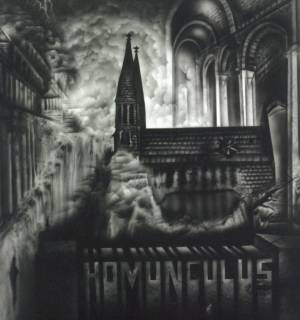
"Frohmader's musical compositions have been said to be the musical shaping of the artistic works by Giger, specially those used for "Alien", what proves the understanding between both artists and why Giger considers Frohmader to be the perfect composer for the soundtrack for "Alien". Yet apart from this affinity, the compositions created by Frohmader are, above all, the musical equivalent to his paintings, and not only the ones published as the covers for his albums. Thus for example, his first album, "Nekropolis", is a symphony divided into two cycles, the one of the Night and the one of Hell, which contains references to the devils in the Tibetan paintings. In two pieces of "Nekropolis Live", texts extracted from the novel by Lovecraft "On the Mountains of Madness" are recited, together with a poem by Gottfried Benn about a corpse. His series "Homunculus", which he has been publishing in Sweden, is a clear connection with his paintings of evil medieval atmospheres. Or the symphonies "Plague Dances" and "Malleus Maleficarum", from his double LP "Through Time & Mystery - Ending". At the same time, his concerts at cathedrals, both for the music and the place, reflect these mystic-baroque traits.
One of the first things that attracts the attention most in his paintings, is the use he makes of black and white to enhance certain themes or elements. Thus for instance, his landscapes of narrow medieval streets look like pictures extracted from accursed books, and his ghostly Gothic cathedrals have an undeniably evil aura. Looking at some of those black and white elements, as for example the entire series of "Homunculus", it must be admitted that in full color they would not be so very impressive. He also incorporates this technique into photography and even to his own person, and decides he is one of these elements that must appear in black and white. Therefore, he always prefers photos to show him in black and white, instead of color.
Some of his illustrations, as for instance the mass of human remains that presides the cover of his first album, or the poster that is included in his second album, show his vincle to death and Beyond. He sees these universal enigmas as a key for his creativity.
In a great part of his paintings there reigns a nocturnal atmosphere, perhaps enhanced by the timetable of his artistic work; Frohmader has produced his works mostly at night, at least in the past. And an oneiric texture, nightmarish in nature, pervades these paintings as well, so as to try harvest some of the essence of bad dreams, by means of atavistic, ancestral signs, from terror. The final effect is to reflect the things that each observer of the painting would swear to have dreamed in some nocturnal nightmare.
Nevertheless, his work is not as dark as many people believe, and this is an important point. Frohmader has become famous as an "accursed artist" because the most remarkable part of his art is the sinister content, and therefore, this is what is more popularized. In his music there also are passages of light and beauty, a sincere message as opposed to the commercial productions that have appropriated the term "New Age".
In his paintings, he shapes cosmic adventures where the observer can contemplate lakes and rocks made from light, the origin of life fused with the birth and death of suns, exuberant jungles spreading to the horizon, intergalactic starscapes swept by the cold light of nebulae, or simply the Sun rising from the clouds and shedding its light after a storm.
Up to a certain point, the dark and light aspects of Frohmader's art have a chronological distribution throughout his career. And thus we have that in the first years darkness, the macabre, the evil dominate; while in his latter years it is light, beauty, the cosmic, what takes the place of the former. Although in the mid 1980s, with "The Jules Verne Cycle" (two pieces based on two stories by Verne: "The Mysterious Island" and "20,000 Leagues Under the Sea"), this subtle change can already be appreciated, it isn't until 1988 with "Spheres", when Frohmader leaves the dark regions and makes a cosmic voyage towards the worlds of light. This new artistic and aesthetic concept continues in the CD "Miniatures" (1989), whose cover is a painting on the wave of the German futuristic trends of the 1920s - 1930s; as well as in 1990, in the CD "Macrocosm" (released in the United States). The final jump arrives with "3rd Millenium's Choice Vol.1", which closes the circle, and which in a way means a return to the original starting point, even though from a different angle. By the end of 1990, he engages on a trip to the French Brittany, so as to find artistic inspiration and produce a 20 minute film showing landscapes and impressions in his personal style, including music. This music is included in his CD "Armorika", running time 74 minutes, released at the beginning of 1991. The result is a very dense, imaginative work, specially in the themes "Tumulus", "Les Roches du Diable", and "Dolmen". At the beginning of 1992, his CD "3rd Millennium's Choice Vol.2" is released, a meditative excursion that enters science-fiction rather than terror. Later, new, excellent works appear.
COLLABORATIONS, CONTACTS AND INFLUENCES
The relationship between H.R. Giger and Frohmader began when Giger heard music by Frohmader. He felt fascinated and proposed him to make the soundtrack for one of his videos. Frohmader accepted, and from this point a productive relationship between them both developed. Giger claims that he usually paints listening to Frohmader's music. On the other hand, Frohmader admits that he has been influenced in his paintings by Giger.
He is a good friend of Florian Fricke, the alma mater of the mystic music band Popol Vuh, known for their cosmic music since the early 1970s, as well as their movie soundtracks for German movie -maker Werner Herzog at an international level.
Musically speaking, he has collaborated with Ax Genrich from Guru-Guru, and Christoph Karrer from Amon Düül-2, members from two legendary bands of German psychedelic music, predecessors to the New Age movement. In his recordings sometimes collaborate violinists Stephan Manus and Iva Bittová, Stephan Seithel (Oboe), Birgit Metzger (vocals), and others. Through Nekropolis Records, his record label, he has produced CDs from other interesting alternative musicians, as for instance Andreas Merz and Gerd Schedel (two electronic experimental composers from Munich), and Gulaab.
He has worked with the painters of contemporary fantasy art Ernst Fuchs and Hellmut Neukircht; and he has been in contact with sculptor Martin Schöneich as well as painters Wolfgang Ohlhäuser and Elke Wassmann.
Among his influences we find the Gothic horror movies from silent movies, as for instance the "Nosferatu" by Murnau, besides the metaphysical science-fiction movies from Russia and Poland, among them "Solaris" and "Stalker". As for the writers who have influenced him most, these are: H.P. Lovecraft (whom he has illustrated), Edgar Allan Poe, Clark Ashton Smith, Henry James, Bram Stoker, Algernon Blackwood, among less known ones. Besides Giger, the painters who have influenced him most are Bosch and Grünewald."
Please no citation or reproduction of any original writings or images appearing on this blog without the permission of its authors.
"Defects of empirical knowledge have less to do with the ways we go wrong in philosophy than defects of character do; such as the simple inability to shut up; determination to be thought deep; hunger for power; fear, especially the fear of an indifferent universe" (David Stove The Plato Cult and Other Philosophical Follies 1991: 188)


 A few days back we told y'all the rumor that Ridley Scott's classic