Showing posts with label ludology. Show all posts

Monday, 27 December 2010

Becoming our own intelligent designers? A consideration of our possible cosmic development

As usual, it takes me a while to get back to topics I'd previously mentioned I might post on. Other commitments are always to blame. It was still quite a year for the Acheron team. We realized a dream of seeing Laurie Anderson performing live at the Sydney Opera House. We also took in China Mieville giving a live reading of selections from his latest book, Kraken. Fascinating as each was in their own right, for me it is always best when things can be brought together, rather than be treated as discrete episodes to be judged on their own respective merits.

Mieville mentioned how he uses Samuel Delany in his creative writing class at Warwick University. Derridata in turn leaked this information to one of Delany's confidants, and "Chip" himself was eventually tipped off! Great as that was, I was particularly interested in how Mieville briefly situated himself in relation to Lovecraft. He mentioned spending more time of late in Providence to get a "feel" for the place, so no doubt we'll soon see what dividends that yields for his upcoming "weird fictions". More forgivingly than was generally Lovecraft's want, Mieville also professed his atheism, while at the same time distancing himself from the "celebrity atheism" of Dawkins et al-- conceding that faith can play a positive role in some people's lives. In contrast, Lovecraft only begrudgingly allowed that Catholicism could inform aesthetics in a worthwhile sense.

Given Mieville's involvement in an upcoming academic conference called Spaces of Alterity, I'm wondering whether he or the other participants will be willing to build upon the aforesaid comments by considering how "the sacred" could inform conceptions of "counter-hegemonic space". I'm thinking here of those who have considered how our planet can be rethought by grounding "the possibility for a Global Ethic that will provide hospitality to all aliens, near and far". The relationship between "the sacred" and "astrobiology" appears set to become an ongoing concern. If you check out the website, you can see that Laurie Anderson was involved too. I mention this fact in part because it is suggestive of a certain consistency to the cultural tastes and interests of the Acheron team as well.

I would describe Anderson as a progressive artist, but whenever I find myself becoming more pessimistic about our prospects for venturing very far, I feel closer to Lovecraft. Afterall, his stories were predicated on panspermia bringing the human race into contact with higher civilizations that were indifferent to us. At no time did he suggest that we could ourselves learn to direct the process to progressive ends. In contrast, Meot-Ner and Matloff in effect follow Carl Sagan and Francis Crick by suggesting that panspermia could be used to create a "Noah's Ark" to save species threatened by changes to Earth's ecosystem, or even changes to the solar system, such as the death of the sun.

Once you start following these debates, you soon realize that any receptiveness to such notions is dependent on how you interpret "the sacred":


I find it ironic then (during my more optimistic, or rather, "utopian" moodswings) that even the proponents of the "selfish gene" theory will attempt to appear responsible by urging us to adhere to the cautionary principle: i.e. notwithstanding natural selection, we are not just driven by our genes, insofar as we are also cultural beings that must be held accountable for our choices and acts. But if the end result is merely a deferential attitude to the order of Nature, how desirable is it really? Surely the greater challenge is to think of how directed panspermia could forge cosmic development as a counter-hegemonic practice; a space irreducible to privatisation, commodification, homogenisation etc? I anticipate that the "Spaces of Alterity" conference will reference Nick Dyer Witheford's Games of Empire, which envisions gaming environments as an example of such spaces. That is fine, as far as it goes. But it stops well short of the ambitious economy of scale Kim Stanley Robinson has in mind when he presents terraforming as a utopian project. To my mind, this distinction makes Robinson the most important science fiction author working today.

For some, building on an impetus for terraforming/directed panspermia will mean hitching the Intelligent Design wagon to Fred Hoyle's The Intelligent Universe. I understand the basic reasoning, which would aim to show the continuity between us taking control of cosmic development and the will of God. In a comparable vein, the conjoining of Islam and science fiction is notable. Others, such as Robinson, are likely to be more muted so far as any specific privileging of religion per se is concerned.


Be this as it may, this group would probably, at least in principle, broadly assent to us collectively becoming our own "intelligent designers". This is light years away from the central message of Lovecraft (and arguably much of "weird fiction" as well) or what is for many the classic sci fi movie of all time-- 2001: A Space Odyssey. Just watch the Flash animation in Part IV and you'll see what I mean.

I won't speculate any further then about what I'd like to see featuring in the "Spaces of Alterity" conference. So I'll just reiterate that I enjoyed China Mieville's talk. Kraken inspired me to create an image of Cthulhu laying waste to Sydney. I'm also posting a few pics of China giving his reading.


Monday, 29 June 2009

chilling out in the cities of the dead

Other commitments have swallowed up my blogging energy of late, but I've just read an extraordinary essay that breathes new life into many of the interests featured on this blog. I was doing some research for a new post on dark ambient music, but it seems I'll have to put that on the backburner. Until an opportunity arises then, here is something that speaks to me theoretically, in a way that nothing else I've read in the musical blogosphere has ever managed to do thus far.

Having read the piece I can now start to weave together thoughts about soundscapes in my mind. For example, let's imagine The Place Where the Black Stars Hang as a soundscape of space archaeology, and then relate these thoughts to the album's conditions of production and consumption. This essay allows me to hear Thomas Koner, Burzum, Lull et al in a new light. It's not as simple though as applying the insights of Roger Caillois, for example, given the dystopic inflection of these artists under review. Actually, allow me to rephrase that. I believe that the Caillois style reading of "play", "imagination" and "nature" is functionally equivalent to the interpretation of Myst in the book Digital Play, meaning that the de-centering [sic] of any signs of human labour in such instances follows on from the Doom-like entropic misanthropy of "isolationatism" evoked in dark ambient. Perhaps it's no coincidence then that artists in the latter genre are prone at times to abjuring rational planning and collaboration, substituting instead chaosmagik, [Nazi style] paganism, Deep Ecology etc. I'll hopefully get to say more about this later after refining my model thanks to an interesting essay by Michael Moorcock on the inherent limitations of libertarian and survivalist science fiction (i.e. there seem to be considerable crossovers between the latter, the virtual worlds featured in games, and dark ambient soundscapes).

But first, here's a representative sample from the mindblowing essay in question:

Perhaps one reading of the death of ambient is precisely in the failure to articulate an urban pastoral. The shift from an ambient music based on a pastoral idyll to an almost regressive pessimism could be attributed to a form of the pastoral which condemns the city, unable to sound within its steel canyons a harmonious ideal. However, this would not explain the pleasure produced by these dystopian soundscapes. One could argue that the New York art establishment only embraced ambient music in 1994 when this sort of dystopianism assumed declarations of avant-gardism.

Ambient music may bite the dust, nonetheless the ambiance of the city continues to surround us. If our cities are deceased and our ambiance DOA, then it is because spectacle culture purports to have raised the scene of social exchange to the plateaux of trans-national labor forces and global markets. In this environment, the interest owed on our musical enjoyment is in fact a global debt. A vital task for the composers of ambiance, then, would be to conduct a psychogeography of global space. One strategy for such a psychogeography of global space would involve an alliance of artists (ambient and otherwise) incorporating the culture of lawlessness and violence promoted by trade accords like the North American Free Trade Agreement and the World Trade Organization. By claiming a subjectivity out of NAFTA, artists could devise strategies of cooperation (the mystifying buzz word of free markets) based on an erotics of ambient sound. This strategic cooperation would empower local artists through international action which utilizes and undermines the same capitalist flows.

Something must be done, if only to rescue our enjoyment from the deceptions of "chance" sublimation. As Deleuze and Guattari suggest, the death enterprise serves only the designs of sublimation and capitalist appropriation.

In the world of popular music, it seems our entire culture preoccupies itself with the business of pronouncing death. From the subcultural death of ambient music and the mainstream embrace of electronica as a reaction to rock's demise, all the way through to the received wisdom that the Left is dead. Rather than properly asking from where this wisdom originates, we all too often devour these sound-bytes and spit out the logic of capital.


Sunday, 21 June 2009

Alien-ation/species being/Sim capital

And what could more perfectly encapsulate Cybermarx's concerns in this instance than a preview of the latest instalment in the Aliens vs Predators franchise? (thanks ahuthnance for the tipoff). I concur that Alien[sic] ation "takes on a whole new meaning" in this context, premised, as it is, on the meeting of "sim capital" and the military-entertainment-complex. Moreover, the game may [eventually] prove prescient in the sense that the conditions of its production, in tandem with its explicit thematic concerns, reflect how technoscience, particularly its biological applications, are increasingly playing a constitutive, rather than an after the event role, in the shaping of social relations more generally, (inclusive of the "bioprospecting" taking place in poorer nations; here as well there is an uncanny parallel with the "colonial marines" featured in the Alien series, who have simply shifted such activities "offworld").

I recommend viewing the video to help flesh out Cybermarx's words, but don't even think about wasting your time by not watching it in High Definition. Be sure to savour the unselfconscious commentary by the games developer, as he demonstrates the capital spectacle of "trophy kills", which consist of the evisceration of human victims by the Predators (due to its graphic nature, the clip requires age verification). Here then is the passage on "sim capital" that particularly grabbed my attention:

What is at stake in the development of "general intellect" is nothing less than the trajectory of species being. "Species being" is the term Marx uses refers to humanity's self-recognition as a natural species with the capacity to transform itself through conscious social activity. In the era of general intellect the application of social knowledge to production make this issue urgent and concrete; e.g. the Human Genome Project. Given this context, the recent revival of the concept of species being by authors such as David Harvey and Gayatri Spivak, rather than constituting a reversion to a much-reviled "Marxist humanism," marks a crucial consideration about the collective control and direction of a techno-scientific apparatus capable of operationalizing a whole series of post-human or sub-human conditions. Alienation takes on a whole new dimension when it reaches up to the creation of "alien" - non-naturally occurring - life forms, and when the cut and paste biology of gene splicing and xenotransplants makes the body itself tend toward the status of "digital cultural object."

Monday, 18 August 2008

"GIVE US YOUR OIL OR WE WILL KILL YOU..." (Militainment Inc.)


In case anyone needs to be further convinced as to the prescience of Nick Turse's The Complex, as previously featured on this blog, it is worth checking out the related investigations in the clips I'm posting here. My post on avid toy collecting also obliquely touched on this subject too, but I neglected to include a shot of the President Bush figurine. In combination the clips provide the full story, namely just how significant that manifestation of militarism really is....
I've been following a few other stories about the simulations of the military entertainment complex. The next clip is the trailer for the post apocalyptic epic, Fallout 3, which I understand is produced by the developers responsible for Elder Scrolls: Oblivion.

Aside from the compelling narrative of its protagonists emerging from their enormous underground shelters to forage and skirmish in the decimated urban environment, some would also be aware of the controversy following media claims its imagery of Washington D.C. had featured in terrorist propaganda. Note the parallels with the militainment clip with respect to the "hostage" [sic] video of the captured American combatant.


Anti-Terror Consultants Deny Report That They Classified Fallout 3 Screenshot as Al Qaeda Material
US Anti-Terror Consultants Deny Report That They Classified Fallout 3 Screenshot as Al Qaeda Material
May 30, 2008
UPDATE: The SITE Intelligence Group has issued a press release which says, categorically, that the article in the Telegraph (upon which this story is based) is wrong. From SITE:

On May 30, 2008, the Telegraph newspaper ran a misleading story... which incorrectly and falsely described analysis provided by the SITE Intelligence Group.

Discussing a computer-generated image of a destroyed Capitol Building in Washington that was posted to a jihadist forum, the Telegraph claimed, without any basis, "The SITE Intelligence Group said that the image, showing a ruined Capitol Building in Washington, was created by extremists as part of discussions about the feasibility of nuclear strikes against the US and Britain."

This claim is entirely false, as is the characterization that SITE is "embarrassed" or "red-faced." SITE rejects the claims by the Telegraph and stands fully behind the accuracy of its information and analysis. SITE at no time maintained that the image "was created by extremists."
(original story follows:)

A US defense contractor has mistakenly identified a screenshot from the upcoming Fallout 3 role-playing adventure as an al Qaeda-created graphic.

As reported by the Telegraph, the SITE Intelligence Group claimed that the image (seen at left) was created by terrorists as part of an al Qaeda investigation as to the feasibility of launching nuclear attacks against the US and UK.

From the newspaper report:

The images appeared in a video, called Nuclear Jihad: The Ultimate Terror, posted on two password-protected websites... believed to be affiliated with al-Qa’eda. SITE also released translated several chatroom threads... discussing the possibility of nuclear attacks on the West.

However, it has transpired that far from being a detailed simulation created by terrorist masterminds, the apocalyptic vision is in fact lifted from the computer game Fallout 3, by US game designers Bethesda Softworks.
The Rupert Murdoch-owned newspaper The Australian was among news outlets which ran the story including SITE's claim that the graphic was an Al Qaeda product.

This isn't the first time that video game graphics have shown up in US intelligence reports on Islamic terrorism. As GamePolitics reported in May, 2006, footage from EA's popular first-person shooter Battlefield 2 and even a voice-over from the film Team America: World Police were presented to the House Select Committe on Intelligence as al Qaeda propaganda.


And what of these uncanny parallels?:
Did Ghost Recon Predict Russia-Georgia Conflict?
August 13, 2008

A number of GamePolitics readers have suggested that Tom Clancy's Ghost Recon, a 2001 first-person shooter, foreshadowed the current hostilities between Russia and Georgia.
The Bulletin serves up a detailed analysis:
Sometimes life imitates art, rather than the other way around, and the 2001 video game "Tom Clancy's Ghost Recon" stands as a prime example. The game... accurately predicted the eruption of hostilities between an expansionist Russia and Georgia... the player takes on obstacles posed by South Ossetian rebels intent on creating a pretext for a Russian invasion.

The game's opening sequence features a Russian leadership intent on bringing the former Soviet republics back under its control. The narrator describes a Russian leader eerily similar to Vladimir Putin... As the game's intro opens, a lone 2008 flashes on the screen before the narrator reads the following words: "The year is 2008, and the world teeters on the brink of war. Radical ultranationalists have seized power in Moscow - their goal, the reestablishment of the old Soviet empire... The world holds its breath, and waits."
The Bulletin also points out that the National Review Online has noticed the eerie similarity between game and real-life events in
McCain, Obama Respond to Scenario Out of First Level of 'Ghost Recon.

Friday, 27 June 2008

Transsubjectivity: Digital Futures


I couldn't resist posting a picture of Hideo Kojima's appearance at a launch event for the latest instalment of Metal Gear Solid, where he took the stage to the strains of Joy Division's "Atmosphere" (Kojima is known to be a huge fan of their work, with part 2 of MGS subtitled "Substance". He also adores Stanley Kubrick).
This got me thinking about the possible cross-overs with film proper, particularly anime, so I then came across the work of Matt Hanson, which appears to challenge my preconceptions of these relationships. In his book The End of Celluloid, Hanson chronicles how filmmaking is being superseded by a "spectrum of moving image...The book presents an insight into these new styles infiltrating the mainstream, taking in film, animation, FMV and machinima (computer gaming animations), digital tv, pop promos, websites, PDA and PVP devices."
Ckeck out the roster of featured artists in the book:

Jonas Åkerlund (Spun)
Roger Avary (Rules of Attraction)
Matthew Barney (The Cremaster Cycle)
Danny Boyle (28 Days Later)
Chris Cunningham (Flex, Windowlicker)
Mike Figgis (Hotel, Timecode)
Grant Gee (Meeting People is Easy)
Lars von Trier (Idioterne)
Peter Greenaway (The Tulse Luper Suitcases)
Hideo Kojima (Metal Gear Solid series)
David Lynch (Rabbits, The Third Place)
Koji Morimoto (Noiseman Sound Insect)
Hideo Nakata (Ringu)
Marc Evans (My Little Eye)
Ken Thain (Rebel Vs Thug)
Mark Neale (No Maps for these Territories)
Mamoru Oshii (Avalon)
Kinematic (9-11 Survivor)
Bill Viola (The Greeting, The Passions)
Kieran Evans & Paul Kelly (Finisterre)
C-Level (Endgames: Waco Resurrection)
Strange Company (Eschaton, Steelwight)
Richard Linklater (Waking Life)
Simon Pummell (Bodysong)
Fumita Ueda (Ico)
Shynola (Radiohead blips & music videos)
Kasuhisa Takenouchi (Interstella 5555)
Sabiston & Pallotta (Roadhead, Snack & Drink)
Janet Cardiff (The Telephone Call)
Andy & Larry Wachowski (Animatrix, The Matrix trilogy)


I don't know at present to what degree Hanson's work touches on the theoretical concerns of someone such as Sean Cubitt (not sure if he is like Ken Wark or not), or even, much to derridata's horror, the itinerant academic career of "Moodle", but anyway, here is a link to Hanson's blog, and below that, a quite lengthy lecture he delivered (poor audio quality though, so it requires patience to sit through it):
Finally, here is a taste of how Linklater's adaptation of A Scanner Darkly is treated as symptomatic of an emergent form of subjectivity, with reference to Arctor's speech, delivered while wearing his scramble suit (I suspect the gist of this approach is comparable to Scott Bukatman's recent book on special effects and subjectivity):
"There are a number of different ways to argue that the mind-game film is symptomatic of a relatively new conception of subjectivity - one that has emerged over the past 10 years and under the influences of technological restructurations and scientific preoccupations. This notion is usually assembled under the header of ‘the posthuman’, although it in fact has little to do with not-being-human-anymore. Posthumanist issues such as artificial intelligence and consciousness lead to a conception of the human individual that does not pose a break from humanity, but rather a move away from a historically-developed and culturally distinct sense of humanism which involves individuality, uniqueness, truth, objectivity, embodiment, freedom, will, and agency. Very much in line with the posthuman, Garrett Stewart proposes the term “postsubjective virtuality” for what happens in films akin to those I have mentioned, though for the underdetermination of images, perspectives, and validity that I take as determinants in my corpus, I prefer the term “transsubjective”.
This choice is partly in order to avoid confusion with the Lacanian and Lyotardan understanding of intersubjectivity as a social phenomenon of communication and meaning-production, and partly to emphasise the transferable, borderless, and unstable nature of subjectivity amidst the technological and psychological distortions of mind-game films.
Identity is the key arena for all these distortions to be played out: like many mind-game films, A Scanner Darkly is riddled with doppelganger motifs, counter-identities, amnesia, and split personalities. Without entering the realm of cyborgs, the questioning, fragmentation, and splitting of identities in A Scanner Darkly establishes a similar discussion of human identity, consciousness, and subjectivity. Arctor finds his identity muddled not only by the surveillance of himself he is forced to process, but also by the dwindling of his mental faculties due to the drugs he has himself become addicted to during his undercover narcotics investigation. All these internal and external influences contaminate any clear-cut, coherent sense of self; Arctor perfectly illustrates the posthuman notion, here phrased by Slavoj Žižek, that:
At the level of material reality (inclusive of the psychological
reality of “inner experience”) there is in effect no Self: the Self
is not the “inner kernel” of an organism, but a surface-effect. A
“true” human Self functions, in a sense, like a computer screen:
“What does a scanner see?”
what is “behind” it is nothing but a network of “selfless”
neuronal machinery.
In a fitting scene, Arctor delivers a work speech in his scramble suit, but suffers extreme discomfort halfway. His perceptions of the audience are truly caught in the prism of filmic representation: before the blur of his scramble suit, we see the markings “Live” and “HQ” within what is supposedly Arctor’s vision. Arctor’s subjective perceptions appear filtered by the panoptical reign of his employer; our perceptions of the film are filtered by its logic of surveillance and mediation".

“What does a scanner see?”
Techno-fascination and unreliability in the mind-game film

Laura Schuster


Thursday, 26 June 2008

"Not tonight dear, I have to reboot": Predictions of Robot Intimacy


I have to acknowledge The New Atlantis as comparable in quality to the kind of intelligent conservatism offered by Robert Manne (who has proven himself one of the most perceptive critics of the Howard era, in contrast to gasbags such as Andrew Bolt, Paddy McGuiness and Piers Akerman). The following piece appeared a while back, so it has taken this long to clear my schedule enough to mention it here. I see it as a companion piece to not only my earlier posting on "Mangobot" and Japanese robotics, but the documentary Arguing the World, which captured my attention many years ago, and traced the origins of the neocon intellectuals, such as Irving Kristol, who were contemporaries of sociologists such as Daniel Bell that later moved to the Right; this is significant because in his book The Cultural Contradictions of Capitalism Bell in effect breathed new life into longstanding fears (e.g Culture and Anarchy) about the corrosive effects of cultural populism (later focused by other critics on postmodernism/cultural studies) as well as the emergence of the postindustrial "information society".
It is fitting then that The New Atlantis continues in this vein, and manages to do so by sounding like common sense, that is empirically grounded, rather than devolving, in the final instance, on some conception of an unchanging "human nature". Or rather, it is underwritten by a peculiar form of essentialism, perhaps with an elective affinity to Intelligent Design advocates, that we humans are too protean and complex to be programmed or imitated by any form of Artificial Intelligence.
This is exactly the kind of claim that Artificial Life advocates have more explicitly set out to challenge with their references to autopoiesis crosscutting all lifeforms. This does little in itself though to challenge the observation that even in the so-called "robot kingdom", Japan, such initiatives have been generally unsuccessful thus far in gaining acceptance (anyone watching the clip I've included of Paro, will quickly see why it failed in hospitals; it is simply annoying).
On a more theoretical plane, one can easily picture an army of Lacanians waiting in the wings to seize on the implications of the following statement (the "mirror stage" writ large):
"It is important, Breazeal emphasizes in her published dissertation Designing Sociable Robots, “for the robot to understand its own self, so that it can socially reason about itself in relation to others.” Toward this goal of making conscious robots, some researchers have selected markers of self-understanding in human psychological development, and programmed their machines to achieve those specific goals. For example, Nico, the therapeutic baby bot, can identify itself in a mirror. (Aside from human beings, only elephants, apes, and dolphins show similar signs of self-recognition.) Kismet’s successor, “Leo,” can perform a complicated “theory of mind” cooperation task that, on the surface, appears equivalent to the psychological development of a four- or five-year-old. But these accomplishments, rather than demonstrating an advanced awareness of mind and self, are choreographed with pattern recognition software, which, though no small feat of coding cleverness, has none of the significance of a baby or an elephant investigating himself in a mirror".
And this is to say nothing of the fitting critique of Rodney Brooks' materialist reduction of humans to "nothing more than machines", letalone the delightful skewering of David Levy's Love and Sex With Robots:
"The latter half of Levy’s book, a frighteningly encyclopedic treatise on vibrators, prostitution, sex dolls, and the short leap from all of that to sex with robots, scarcely deserves mention. Levy begins it, however, with the familiar story of Pygmalion, in a ham-handed act of mythical misappropriation".
Very entertaining to be sure, but more compelling from a sociological perspective is the observation that sociality is not something that can be simply programmed in advance, but is in need of continual structuration (to employ Giddens' apt phrase). This is something I've noticed a lot recently, not only in regard to Randall Collins' work on interaction rituals and Artificial Life, but also in efforts to apply Sennett's conception of "craft" to ethnographies of virtual environments. The necessity here is one of gaining an understanding of the world as something which resists us, thus prompting a need to continually refine an autotelic self; hence repetition ideally implies an articulate, rather than compulsive, engagement with difference (in effect lending a new inflection to one of my favourite terms, seriality).

Tuesday, 1 January 2008

Sexual Robots and Plastic Humans


Legendary post-punk musician, artist, biomorphic horror technician and theoretician Philip Brophy offers a very interesting podcast here on representations of technology in anime. I must later archive some of Brophy's earlier music on this blog as well. Unfortunately, youtube is not carrying his short film "Salt Saliva Sperm and Sweat", which would have made an incredible companion piece. Derridata and I saw it on video in about 1990, which seems incredible now, as I was able to get it at the local store, and since then it has become difficult to find. I will also monitor his contributions to the "Cinesonic" seminar series.


Another thought occurs to me; was Phil an influence on Thug and, even further back, how much of a contemporary was he with Jim Foetus????


http://lamp.edu.au/2006/06/07/podcast-sexual-robots-and-plastic-humans/

Sunday, 2 December 2007

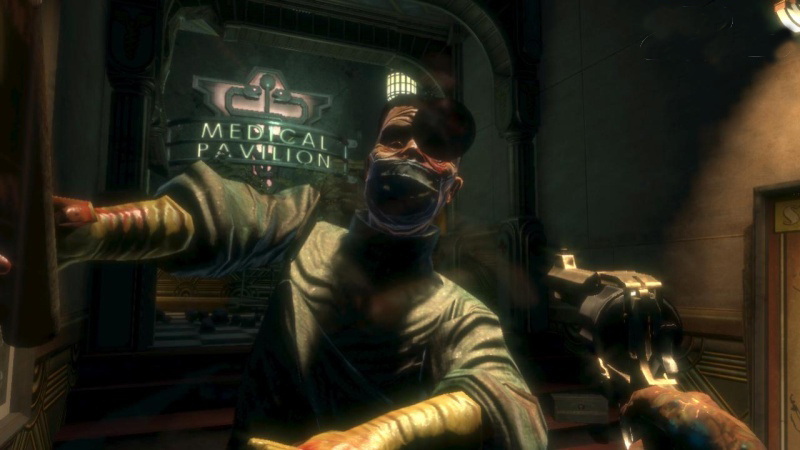
Bioshock


Derridata, remarkable coincidence your post on Heidegger, in light of the fact that I've been playing Bioshock a lot lately. It occurred to me that Andrew Ryan, the creator of the underwater libertarian paradise known as "Rapture", manifests many of the same tendencies, albeit shorn of Heidegger's anti-technological animus. I wonder then if we will start to see ludologists and scholars of thanatourism speaking to each other across disciplinary boundaries. And what of the possible ramifications for virtual "island studies", here referencing the new journal cited in my previous post?


Thematically, the game is distinguished by the complexity of the moral choices faced by the player. By considering these, we can avoid the simplistic analysis of Ken Wark that, "ever get the feeling that all of life is becoming like a game?" No, not really Ken. It seems more to be the case that in either environment, the player, or the tourist, is presented with moral choices, that they can choose to act on. As per the Hobbesian Leviathan, the debauched farangs foregrounded in my posts on Thailand's "zones of indistinction", Andrew Ryan pitches the appeal of his paradise in a very thin liberal conception of citizenship. I say this because liberalism in a sense must remain radically anti-utopian, in that too much of a prescriptive approach to "the good life" is seen as imperilling the freedom of the individual to come together in their own fashion and realise their desires through market interactions. Unsurprisingly then, Ryan is more interested in offering a rationale for Rapture that says more about what it is not, rather than what it is:


"I am Andrew Ryan and I'm here to ask you a question: Is a man not entitled to the sweat of h is brow? No, says the man in Washington, it belongs to the poor. No, says the man in the Vatican, it belongs to God. No, says the man in Moscow, it belongs to everyone. I rejected those answers. I chose something different. I chose the impossible- I chose Rapture- a city where the artist would not fear the censor. Where the scientist would not be bound by petty morality. Where the great would not be constrained by the small. And with the sweat of your brow, Rapture can be your city as well".


Suffice to say, things quickly go pear shaped in Rapture. Set in 1959, the game cannily anticipates the failure of Francis Fukuyama's "end of history" thesis, witness the widesperad disenchantment and rebellion against neoliberal commodification. Rapture has degenerated into a world where mutated children roam the streets, harvesting genetic material from corpses. Assorted other mutations, some of whom are known as "Lead Heads, in what is probably an acknowledgement of the "Chicken Heads" in "Do Androids Dream of Electric Sheep?", are also encountered at various points. Some espouse bizarre litanies in a desperate attempt at salvation, only to then break into random acts of violence. There are also those who have undergone grotesque mutation through gene splicing, and wear vaguely A Clockwork Orange style masks in an attempt to disguise their misshapen features.


In fact, the retro futurist architecture and character design are so exquisitely detailed, an exhaustive description remains beyond my capacity. I've chosen a few choice pics instead. Unsurprisingly, the New York Times have described Bioshock as "one of the greatest games ever made".