Before I get round to posting sometime on the Acheron team's postmortem of Brian Eno's lecture (which we took in last Friday), I thought I'd dig around a bit more for material related to the politics of modernism. Mhuthnance, you were expressing regrets about not getting to the Salvador Dali show, but have you read this? Something else I've found particularly rewarding of late is Junk for Code's critical appraisal of Hans Bellmer. After dwelling on that for a while I somehow ended up at the clip for the gigantic marionette doll I've posted here. I find it quite eerie because, aside from any Bellmer-like associations, it brings to mind the closing scenes of Paprika.
Monday, 1 June 2009


Tuesday, 19 May 2009
Air Doll
Michael Guillén: Congratulations on being selected for this year’s Un Certain Regard with your new film Air Doll. I’m interested in what you were seeking to explore thematically in your latest film?
Hirokazu Kore-eda: The doll is inflated with air, so it’s basically empty or blank inside. She is living in Tokyo and around her are us urbanites who are also empty. We have nothing inside of us either and we are isolated. I wanted to explore the emptiness, the loneliness that is felt by the inflated doll and the isolated urbanites.
Monday, 18 May 2009
Contact Zones
Reviewing the "Toshiya Ueno" post, it dawned on me that what he had written in Aliens R Us contradicted his assessments of communitas, Victor Turner etc, to some extent. For in that essay he describes the mediating "shamanistic" ritualistic role of the DJ at rave parties in almost identical terms to Durkheim's explanation of aboriginal corroboree in Elementary Forms of the Religious Life. So I would say that in the subcultures text I also linked to, he manages to qualify Turner, but certainly doesn't prove that communitas is theoretically somewhat "banal", as stated in his interview. Quite the opposite in fact.
What I got out of the subcultures book was the importance of Mary Louise Pratt's concept of "contact zones". I haven't followed the music blogosphere closely enough in recent times to check if the debates about a British "hardcore continuum" referred to Pratt. But if they didn't, it strikes me as unfortunate because another conference recently made use of her work in a way that appears mutually beneficial. A lot of similar questions were asked, and one can even find terms such as "centrifugal" and "centripetal" approximating Simon Reynolds' response to critics on his Energy Flash blog. Moreover, the Contact Zones in Modern British Culture conference specifically refers to musicians to flesh out its arguments!!
Just in case anyone happens to read this who was a participant, or has already read about both events, my apologies if what I have to say here is not exactly news. Part of the problem for me is that I find wading through the Continental philosophy and/or musical blogosphere too offputting. To be more precise, whenever I read such a blog dutifully reporting the details of the latest esoteric subject, [to cite an actual example from Infinite Thought], as per a seminar on the problem of time in Hegel, "moving towards an historical ontology of the social", my first instinctive reaction is usually a series of vivid hallucinations akin to Francis Bacon's depiction of the Pope frying in agony on the electric chair. The telling difference from Bacon's original though is that I've taken the Pope's place and the electric chair is in the seminar room. So unless there is adequate scope for such a reading method to dialogue with a social epistemology, I generally won't feel the stakes are sufficiently high enough to warrant the risks to my mental and physical health, which would surely follow from a more protracted encounter (i.e. I'm only attracted to those debates that are able to also encompass issues of epistemic justice. An example of a precedent would be unpacking how and why the Hegelian Alexandre Kojeve became a neocon guru).......OK, I admit the severity of my reactions as described here were somewhat exaggerated for comical effect, but you still catch my basic drift, right?
For now then I'm inclined to await publication of conference proceedings to gain a firmer conceptual grasp on "contact zones". I believe Pratt's considerable endeavours are potentially complementary to the theory and method of articulation, as originally developed by Stuart Hall: for researchers interested in musical genres and scenes, it brings into alignment (i.e. contact) the elements that constitute something like the analytical program known as the sociology of rock, in a manner that will [of course] change on a case by case basis.
What I got out of the subcultures book was the importance of Mary Louise Pratt's concept of "contact zones". I haven't followed the music blogosphere closely enough in recent times to check if the debates about a British "hardcore continuum" referred to Pratt. But if they didn't, it strikes me as unfortunate because another conference recently made use of her work in a way that appears mutually beneficial. A lot of similar questions were asked, and one can even find terms such as "centrifugal" and "centripetal" approximating Simon Reynolds' response to critics on his Energy Flash blog. Moreover, the Contact Zones in Modern British Culture conference specifically refers to musicians to flesh out its arguments!!
Just in case anyone happens to read this who was a participant, or has already read about both events, my apologies if what I have to say here is not exactly news. Part of the problem for me is that I find wading through the Continental philosophy and/or musical blogosphere too offputting. To be more precise, whenever I read such a blog dutifully reporting the details of the latest esoteric subject, [to cite an actual example from Infinite Thought], as per a seminar on the problem of time in Hegel, "moving towards an historical ontology of the social", my first instinctive reaction is usually a series of vivid hallucinations akin to Francis Bacon's depiction of the Pope frying in agony on the electric chair. The telling difference from Bacon's original though is that I've taken the Pope's place and the electric chair is in the seminar room. So unless there is adequate scope for such a reading method to dialogue with a social epistemology, I generally won't feel the stakes are sufficiently high enough to warrant the risks to my mental and physical health, which would surely follow from a more protracted encounter (i.e. I'm only attracted to those debates that are able to also encompass issues of epistemic justice. An example of a precedent would be unpacking how and why the Hegelian Alexandre Kojeve became a neocon guru).......OK, I admit the severity of my reactions as described here were somewhat exaggerated for comical effect, but you still catch my basic drift, right?
For now then I'm inclined to await publication of conference proceedings to gain a firmer conceptual grasp on "contact zones". I believe Pratt's considerable endeavours are potentially complementary to the theory and method of articulation, as originally developed by Stuart Hall: for researchers interested in musical genres and scenes, it brings into alignment (i.e. contact) the elements that constitute something like the analytical program known as the sociology of rock, in a manner that will [of course] change on a case by case basis.
Saturday, 16 May 2009
Peter Frohmader, H.R. Giger & the "Alien" soundtrack that almost was....
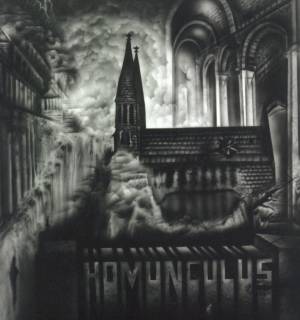
"Frohmader's musical compositions have been said to be the musical shaping of the artistic works by Giger, specially those used for "Alien", what proves the understanding between both artists and why Giger considers Frohmader to be the perfect composer for the soundtrack for "Alien". Yet apart from this affinity, the compositions created by Frohmader are, above all, the musical equivalent to his paintings, and not only the ones published as the covers for his albums. Thus for example, his first album, "Nekropolis", is a symphony divided into two cycles, the one of the Night and the one of Hell, which contains references to the devils in the Tibetan paintings. In two pieces of "Nekropolis Live", texts extracted from the novel by Lovecraft "On the Mountains of Madness" are recited, together with a poem by Gottfried Benn about a corpse. His series "Homunculus", which he has been publishing in Sweden, is a clear connection with his paintings of evil medieval atmospheres. Or the symphonies "Plague Dances" and "Malleus Maleficarum", from his double LP "Through Time & Mystery - Ending". At the same time, his concerts at cathedrals, both for the music and the place, reflect these mystic-baroque traits.
One of the first things that attracts the attention most in his paintings, is the use he makes of black and white to enhance certain themes or elements. Thus for instance, his landscapes of narrow medieval streets look like pictures extracted from accursed books, and his ghostly Gothic cathedrals have an undeniably evil aura. Looking at some of those black and white elements, as for example the entire series of "Homunculus", it must be admitted that in full color they would not be so very impressive. He also incorporates this technique into photography and even to his own person, and decides he is one of these elements that must appear in black and white. Therefore, he always prefers photos to show him in black and white, instead of color.
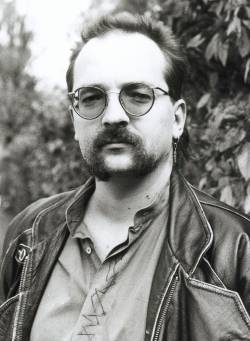 Some of his illustrations, as for instance the mass of human remains that presides the cover of his first album, or the poster that is included in his second album, show his vincle to death and Beyond. He sees these universal enigmas as a key for his creativity.
In a great part of his paintings there reigns a nocturnal atmosphere, perhaps enhanced by the timetable of his artistic work; Frohmader has produced his works mostly at night, at least in the past. And an oneiric texture, nightmarish in nature, pervades these paintings as well, so as to try harvest some of the essence of bad dreams, by means of atavistic, ancestral signs, from terror. The final effect is to reflect the things that each observer of the painting would swear to have dreamed in some nocturnal nightmare.
Nevertheless, his work is not as dark as many people believe, and this is an important point. Frohmader has become famous as an "accursed artist" because the most remarkable part of his art is the sinister content, and therefore, this is what is more popularized. In his music there also are passages of light and beauty, a sincere message as opposed to the commercial productions that have appropriated the term "New Age".
In his paintings, he shapes cosmic adventures where the observer can contemplate lakes and rocks made from light, the origin of life fused with the birth and death of suns, exuberant jungles spreading to the horizon, intergalactic starscapes swept by the cold light of nebulae, or simply the Sun rising from the clouds and shedding its light after a storm.
Up to a certain point, the dark and light aspects of Frohmader's art have a chronological distribution throughout his career. And thus we have that in the first years darkness, the macabre, the evil dominate; while in his latter years it is light, beauty, the cosmic, what takes the place of the former. Although in the mid 1980s, with "The Jules Verne Cycle" (two pieces based on two stories by Verne: "The Mysterious Island" and "20,000 Leagues Under the Sea"), this subtle change can already be appreciated, it isn't until 1988 with "Spheres", when Frohmader leaves the dark regions and makes a cosmic voyage towards the worlds of light. This new artistic and aesthetic concept continues in the CD "Miniatures" (1989), whose cover is a painting on the wave of the German futuristic trends of the 1920s - 1930s; as well as in 1990, in the CD "Macrocosm" (released in the United States). The final jump arrives with "3rd Millenium's Choice Vol.1", which closes the circle, and which in a way means a return to the original starting point, even though from a different angle. By the end of 1990, he engages on a trip to the French Brittany, so as to find artistic inspiration and produce a 20 minute film showing landscapes and impressions in his personal style, including music. This music is included in his CD "Armorika", running time 74 minutes, released at the beginning of 1991. The result is a very dense, imaginative work, specially in the themes "Tumulus", "Les Roches du Diable", and "Dolmen". At the beginning of 1992, his CD "3rd Millennium's Choice Vol.2" is released, a meditative excursion that enters science-fiction rather than terror. Later, new, excellent works appear.
 COLLABORATIONS, CONTACTS AND INFLUENCES
The relationship between H.R. Giger and Frohmader began when Giger heard music by Frohmader. He felt fascinated and proposed him to make the soundtrack for one of his videos. Frohmader accepted, and from this point a productive relationship between them both developed. Giger claims that he usually paints listening to Frohmader's music. On the other hand, Frohmader admits that he has been influenced in his paintings by Giger.
He is a good friend of Florian Fricke, the alma mater of the mystic music band Popol Vuh, known for their cosmic music since the early 1970s, as well as their movie soundtracks for German movie -maker Werner Herzog at an international level.
Musically speaking, he has collaborated with Ax Genrich from Guru-Guru, and Christoph Karrer from Amon Düül-2, members from two legendary bands of German psychedelic music, predecessors to the New Age movement. In his recordings sometimes collaborate violinists Stephan Manus and Iva Bittová, Stephan Seithel (Oboe), Birgit Metzger (vocals), and others. Through Nekropolis Records, his record label, he has produced CDs from other interesting alternative musicians, as for instance Andreas Merz and Gerd Schedel (two electronic experimental composers from Munich), and Gulaab.
He has worked with the painters of contemporary fantasy art Ernst Fuchs and Hellmut Neukircht; and he has been in contact with sculptor Martin Schöneich as well as painters Wolfgang Ohlhäuser and Elke Wassmann.
Among his influences we find the Gothic horror movies from silent movies, as for instance the "Nosferatu" by Murnau, besides the metaphysical science-fiction movies from Russia and Poland, among them "Solaris" and "Stalker". As for the writers who have influenced him most, these are: H.P. Lovecraft (whom he has illustrated), Edgar Allan Poe, Clark Ashton Smith, Henry James, Bram Stoker, Algernon Blackwood, among less known ones. Besides Giger, the painters who have influenced him most are Bosch and Grünewald."
Excerpt from "The Oneiric Prospections of Peter Frohmader" by Jorge Munnshe
Subscribe to:
Posts (Atom)


