This warehouse is being built to house the books and journals that no one wants. With the British Library's UK collection growing at a rate of 12.5km of shelf space a year, is the notion of the copyright library really sustainable? Stuart Jeffries reports
Saturday November 24, 2007
The Guardian
We used to build cathedrals. Now we build warehouses. One of the most extraordinary examples of our costly new dalliance with warehouse technology is rising on an industrial estate in West Yorkshire. As I drive past Leeds United's training ground and past HM Prison Wealstun, an epic grey corrugated temple looms ominously. It dominates the landscape around Boston Spa, just as Ely Cathedral commands the Fens or as Chartres Cathedral surmounts the countryside for miles around. All it needs is a spire.
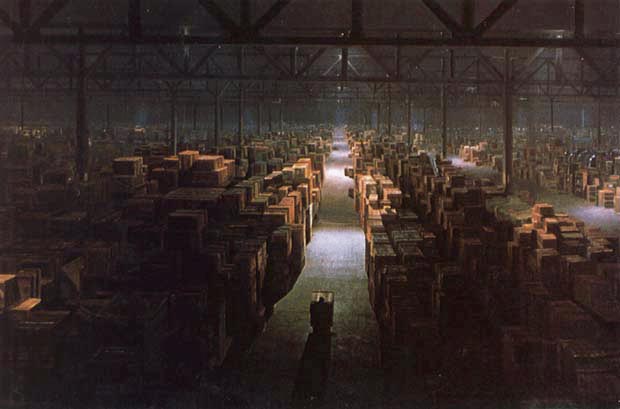
The warehouse is extraordinary because, unlike all those monstrous Tesco and Amazon depositories that litter the fringes of the motorways of the Midlands, it is being meticulously constructed to house things that no one wants. When it is complete next year, this warehouse will be state-of-the-art, containing 262 linear kilometres of high-density, fully automated storage in a low-oxygen environment. It will house books, journals and magazines that many of us have forgotten about or have never heard of in the first place.
Chris Fletcher, the warehouse's project manager for the past 11 months, is extremely proud of it. "Normal atmosphere consists 20% oxygen. This will regulate oxygen in the warehouse to between 15.8 and 16.2%, with a mean of 16%, which will ensure minimal damage to the books in store. The air-conditioning will ensure 52.5% humidity plus or minus 5%. It will ensure a steady state temperature. The whole building will be sealed to protect the contents. It will," he says puffing his chest a little, "comply with British Standard 5454. Amazing, isn't it?"
It certainly is. We're standing in hard hats and wellies inside the warehouse, which at present is a huge shell. It reminds me of visiting an empty power station in south London before they started filling it with art galleries and calling it Tate Modern: the scale induces awe. This will be the £20 million new depository at the British Library's Yorkshire complex in Boston Spa near Leeds. It is where, before this century reaches its teens, copies of books spared a quick death at the pulping plant - thanks to the grace of the provisions of the 1911 Copyright Act and later government legislation - will go to serve their life sentences in a secure environment. "We need this warehouse," says Steve Morris, the British Library's head of finance, "not just because it is cheaper than existing rented warehouses we use in London, but also because we are statutorily obliged to house more and more material. Seven million items, many of them books, will go there. The death of the book has been grossly exaggerated, you see."
Indeed, the problem for our great libraries is that books won't stop coming. The British Library's UK national collection is currently expanding at the rate of 12.5 kilometres of shelf space a year, and somewhere has to be found to put it all. In 1911, the notion of the copyright library was born, when Parliament decided that the British Library along with five others in Great Britain and Ireland would be entitled to receive a free copy of every item published. But, while the other five - the Bodleian at Oxford, Cambridge University Library, Trinity College Library in Dublin, and the National Libraries of Scotland and Wales - have a right to claim any book published in the UK, in practice not all are. Cambridge University Library, for example, estimates that only between 70% and 80% of everything published in the UK are deposited there (they can also request anything within one year of publication). By contrast, the British Library must receive a copy of everything published in the UK each year.
Inside the tomb of tomes
Saturday November 24, 2007
The Guardian
"The future warehouse of unwanted books"
BLDGBLOG