Saturday, 15 December 2007
The Threshold HouseBoys Choir
I think I may have found some answers to my previous queries about Sleazy. A simple google search brought to light how Coil filmed their "Love's Secret Domain" video in Thailand, (in a male go-go bar), with John Balance and Peter Christopherson later channelling their energy into a side project, a group called The Threshold HouseBoys Choir.I'm posting these clips here as I await broadband access so I can not only see if I like the music, but whether the cultural representation is in keeping with any of my hypotheses advanced in the previous post. All I know so far is that the Choir is somehow related to a festival involving the transgression of physical pain thresholds by young men in a trance state. I'm sure derridata will want to point out to me that the Coil clip is not for the title track, "Love's Secret Domain", but I look forward to reviewing it anyway.
Can't help chuckling at the memory of reports of Nick Cave walking out of a Coil live performance on the basis that it was "too gay" for his tastes! Must check if Chris and Cosey have done any interesting videos as well, with any bearing on some of the topics raised thus far.


Europa Rising?



Or, perhaps not....I know ahuthnance is particularly fond of the Abandon Tracks compilation, as am I, because, aside from the excellent selection of songs, we as thantourists visited the very same German tank featured on the cover (it was scuttled by the crew in Vimoutiers, and was slowly sliding down the hill side into a creek. It was salvaged as an historical monument just in time as scrap metal merchants had started cutting it up- however, I can't claim any personal acquaintance with the flaming horse heads featured in the other pic of a corpulent, almost derelict looking Pearce). I thought it was worth putting this link up here as Douglas Pearce is very forthcoming about where he stands politically (use of fascist iconography), his sexuality, the relation of his earlier group Crisis to contemporaries such as Crass. Having read the interview I give him a lot more credit than that other highly dubious embodiment of the "banality of evil", known as Boyd Rice (I did at least read recently that Rice's silly Social Darwinian thinktank Abraxa Foundation has closed down).
A future theoretical assignment worth pursuing would be to situate artists such as Pearce in relation to some of the the resources I've gathered elsewhere on thanatourism. Death in June as architects of thanatourist soundscapes perhaps? I'm also reminded of the criticism Reynolds and Press attracted from some quarters for their book The Sex Revolts, as it was viewed in such instances as propounding "gender tourism" (into the heart of darkness of male psychopathology). It seems to me though that aside from scattershot references to psychogeography and Grossberg's work on the affective colonisation of everyday life, much work remains to be done on the spatial dimension of music in relation to the commodity form of tourism. Musicians are generally referred to as going on "tour", but how exactly are their experiences mediated, what are the most relevant feedback mechanisms that can account for their work which distinguishes it from "leisure" experiences? How are such relationships reflected in the cultural consumption patterns of their fans? Is it proper to speak in terms of the famous study, The Time of the Tribes, if so, is this the most adequate explanation for the globalisation of "the homeless mind" (to quote Peter Berger), as markers of certainty are dissolved in a liquid modernity? (remember, the tourist and the vagabond are two of the archetypes Zymunt Bauman uses to illustrate his sociology of postmodernity, concerned with the relationship between mobility and the feasibility of cultivating ethical relationships with the stranger) As Gang of Four anticipated long ago on their album Entertainment!, "at home he feels like a tourist." Will Chris Rojek start talking about music as the soundtrack to such commodified experiences, or will the field become dominated by hauntologists more fascinated by Jameson's essay on The Shining in tandem with readings of Derrida? Can these preferences be situated by a social epistemology?
And while I'm on this topic, thinking back to the cover story of The Wire, why has Sleazy from Throbbing Gristle relocated to Bangkok? Might this have anything to do with the commodification of the "zones of distinction" discussed elsewhere on this blog? Much investigation required, which seems more than coincidental, once it is accepted that Throbbing Gristle provided a template for many bands, not least of all, Death in June..........
And boy oh boy, isn't the following blog, now primarily an archive it seems, quite a scary sampling of possible elective affinties between Death in June and other cultural phenomenon in general? The blogger profile alone is enough to send folks running to the hills in fear:
Tuesday, 11 December 2007
Spontaneous Generations
I never pass up the opportunity to archive for future reference new open journals if they happen to catch my attention, and the Canadian based History and Philosophy of Science Spontaneous Generations is shaping up as one to keep an eye on. Prominent figures in the field such as Steve Fuller and Michael Lynch are featured, discussing issues such as the democratisation of science and the general state of Science and Technology Studies, alongside writers investigating a variety of other topics such as "Anatomical Expertise and the Hermaphroditic Body".
http://jps.library.utoronto.ca/index.php/SpontaneousGenerations/issue/view/76
Sunday, 9 December 2007
The future warehouse of unwanted books ~ Our era's equivalent of pharaonic tombs
This warehouse is being built to house the books and journals that no one wants. With the British Library's UK collection growing at a rate of 12.5km of shelf space a year, is the notion of the copyright library really sustainable? Stuart Jeffries reports
Saturday November 24, 2007
The Guardian
We used to build cathedrals. Now we build warehouses. One of the most extraordinary examples of our costly new dalliance with warehouse technology is rising on an industrial estate in West Yorkshire. As I drive past Leeds United's training ground and past HM Prison Wealstun, an epic grey corrugated temple looms ominously. It dominates the landscape around Boston Spa, just as Ely Cathedral commands the Fens or as Chartres Cathedral surmounts the countryside for miles around. All it needs is a spire.
Saturday November 24, 2007
The Guardian
We used to build cathedrals. Now we build warehouses. One of the most extraordinary examples of our costly new dalliance with warehouse technology is rising on an industrial estate in West Yorkshire. As I drive past Leeds United's training ground and past HM Prison Wealstun, an epic grey corrugated temple looms ominously. It dominates the landscape around Boston Spa, just as Ely Cathedral commands the Fens or as Chartres Cathedral surmounts the countryside for miles around. All it needs is a spire.
The warehouse is extraordinary because, unlike all those monstrous Tesco and Amazon depositories that litter the fringes of the motorways of the Midlands, it is being meticulously constructed to house things that no one wants. When it is complete next year, this warehouse will be state-of-the-art, containing 262 linear kilometres of high-density, fully automated storage in a low-oxygen environment. It will house books, journals and magazines that many of us have forgotten about or have never heard of in the first place.
Chris Fletcher, the warehouse's project manager for the past 11 months, is extremely proud of it. "Normal atmosphere consists 20% oxygen. This will regulate oxygen in the warehouse to between 15.8 and 16.2%, with a mean of 16%, which will ensure minimal damage to the books in store. The air-conditioning will ensure 52.5% humidity plus or minus 5%. It will ensure a steady state temperature. The whole building will be sealed to protect the contents. It will," he says puffing his chest a little, "comply with British Standard 5454. Amazing, isn't it?"
It certainly is. We're standing in hard hats and wellies inside the warehouse, which at present is a huge shell. It reminds me of visiting an empty power station in south London before they started filling it with art galleries and calling it Tate Modern: the scale induces awe. This will be the £20 million new depository at the British Library's Yorkshire complex in Boston Spa near Leeds. It is where, before this century reaches its teens, copies of books spared a quick death at the pulping plant - thanks to the grace of the provisions of the 1911 Copyright Act and later government legislation - will go to serve their life sentences in a secure environment. "We need this warehouse," says Steve Morris, the British Library's head of finance, "not just because it is cheaper than existing rented warehouses we use in London, but also because we are statutorily obliged to house more and more material. Seven million items, many of them books, will go there. The death of the book has been grossly exaggerated, you see."
Indeed, the problem for our great libraries is that books won't stop coming. The British Library's UK national collection is currently expanding at the rate of 12.5 kilometres of shelf space a year, and somewhere has to be found to put it all. In 1911, the notion of the copyright library was born, when Parliament decided that the British Library along with five others in Great Britain and Ireland would be entitled to receive a free copy of every item published. But, while the other five - the Bodleian at Oxford, Cambridge University Library, Trinity College Library in Dublin, and the National Libraries of Scotland and Wales - have a right to claim any book published in the UK, in practice not all are. Cambridge University Library, for example, estimates that only between 70% and 80% of everything published in the UK are deposited there (they can also request anything within one year of publication). By contrast, the British Library must receive a copy of everything published in the UK each year.
Inside the tomb of tomes
Saturday November 24, 2007
The Guardian
"The future warehouse of unwanted books"
BLDGBLOG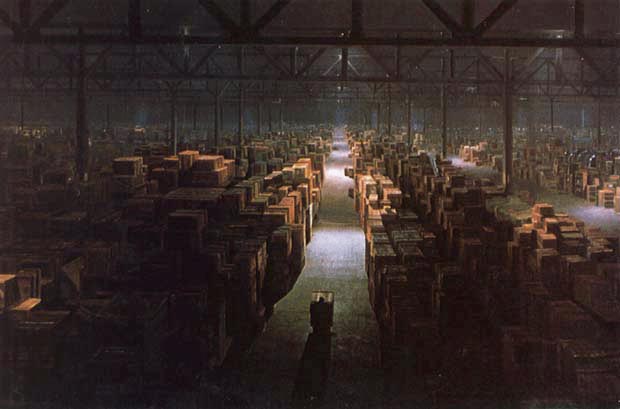
Sunday, 2 December 2007
Bioshock



Derridata, remarkable coincidence your post on Heidegger, in light of the fact that I've been playing Bioshock a lot lately. It occurred to me that Andrew Ryan, the creator of the underwater libertarian paradise known as "Rapture", manifests many of the same tendencies, albeit shorn of Heidegger's anti-technological animus. I wonder then if we will start to see ludologists and scholars of thanatourism speaking to each other across disciplinary boundaries. And what of the possible ramifications for virtual "island studies", here referencing the new journal cited in my previous post?
Thematically, the game is distinguished by the complexity of the moral choices faced by the player. By considering these, we can avoid the simplistic analysis of Ken Wark that, "ever get the feeling that all of life is becoming like a game?" No, not really Ken. It seems more to be the case that in either environment, the player, or the tourist, is presented with moral choices, that they can choose to act on. As per the Hobbesian Leviathan, the debauched farangs foregrounded in my posts on Thailand's "zones of indistinction", Andrew Ryan pitches the appeal of his paradise in a very thin liberal conception of citizenship. I say this because liberalism in a sense must remain radically anti-utopian, in that too much of a prescriptive approach to "the good life" is seen as imperilling the freedom of the individual to come together in their own fashion and realise their desires through market interactions. Unsurprisingly then, Ryan is more interested in offering a rationale for Rapture that says more about what it is not, rather than what it is:
"I am Andrew Ryan and I'm here to ask you a question: Is a man not entitled to the sweat of h is brow? No, says the man in Washington, it belongs to the poor. No, says the man in the Vatican, it belongs to God. No, says the man in Moscow, it belongs to everyone. I rejected those answers. I chose something different. I chose the impossible- I chose Rapture- a city where the artist would not fear the censor. Where the scientist would not be bound by petty morality. Where the great would not be constrained by the small. And with the sweat of your brow, Rapture can be your city as well".
Suffice to say, things quickly go pear shaped in Rapture. Set in 1959, the game cannily anticipates the failure of Francis Fukuyama's "end of history" thesis, witness the widesperad disenchantment and rebellion against neoliberal commodification. Rapture has degenerated into a world where mutated children roam the streets, harvesting genetic material from corpses. Assorted other mutations, some of whom are known as "Lead Heads, in what is probably an acknowledgement of the "Chicken Heads" in "Do Androids Dream of Electric Sheep?", are also encountered at various points. Some espouse bizarre litanies in a desperate attempt at salvation, only to then break into random acts of violence. There are also those who have undergone grotesque mutation through gene splicing, and wear vaguely A Clockwork Orange style masks in an attempt to disguise their misshapen features.
In fact, the retro futurist architecture and character design are so exquisitely detailed, an exhaustive description remains beyond my capacity. I've chosen a few choice pics instead. Unsurprisingly, the New York Times have described Bioshock as "one of the greatest games ever made".
Saturday, 1 December 2007
The ‘nostalgia to be God’
Pierre Bourdieu (on Heidegger):
"Placed in an uncomfortable situation in the dominant class, as an illegitimate bourgeois, stripped of his bourgeois rights and of the possibility of even claiming them…the intellectual can only define himself in opposition to the rest of the social world, categorised as ‘dirty bastards’, that is, as 'bourgeois', but in Flaubert’s rather than Marx’s sense, meaning all those who feel at ease with themselves and secure in their rights because they have the luck and the misfortune not to think. If we agree to recognise in the ‘bourgeois’ and the ‘intellectual’ the existential realisation of what will later become, in Sartre’s philosophically euphemised system, the en-soi (self-sufficient being) and the pour-soi (self conscious being), we will better understand the ‘nostalgia to be God’, that is, the reconciliation of the bourgeois and the intellectual ('living like a bourgeois and thinking like a demigod’, as Flaubert said), of thoughtless power and powerless thought."

"In The Political Ontology of Martin Heidegger ( 1991 ), Pierre Bourdieu...describes [Heidegger's philosophy as registering] a distinct configuration of revolutionary conservative thought, an ideological matrix or system of common mental schemata that engenders the National Socialist vision of the world. No single ideologue mobilizes all of these schemata, which, for this reason, neither fulfill the same functions nor have equal importance in the different systems in which they are inserted. But each thinker is able to "produce, from the particular combination of the common schemata which he mobilizes, a discourse that is perfectly irreducible to the others, although it is only a transformed form of all the others". Bourdieu understands Heidegger's philosophy as one such discourse. This allows him to draw parallels between Heidegger's work and the less formalized discourses of other revolutionary conservative thinkers like Oswald Spengler and Ernst Jnger. Such an approach to Heidegger embodies a "dual refusal, rejecting not only any claim of the philosophical text to absolute autonomy. . . but also any direct reduction of the text to the most general conditions of its production".
"History's stamp: Wyndham Lewis's The Revenge for Love and the Heidegger controversy"
Comparative Literature, Winter 1999 by Brett Neilson
YouTube shuts down Egyptian anti-torture activist's account

Has the YouTube Effect stuck again? Wael Abbas (pictured above), a well-known online activist in Egypt, says his YouTube video account has been suspended and his Yahoo! e-mail accounts have been shut down. Abbas had this pesky habit, you see, of posting graphic videos showing police brutality, and his site had become one of the most popular blogs in Egypt.
In one prominent incident, Abbas posted a video on his blog of a police officer binding and sodomizing an Egyptian bus driver who intervened in a dispute between police and another driver.
The video was one of the factors that led to the conviction of two police officers, who were sentenced to three years each in connection with the incident.
 Police Capt. Islam Nabih, right, was convicted of torturing a bus driver in part because of video Abbas posted.
"There are plenty of other video-sharing sites and third-party tools out there for posting viral videos, but Abbas says he's lost his entire archive, the fruit of years of painstaking work. Also this month, Yahoo! accused Abbas of spamming and shut down two e-mail accounts of his.
"It's too early to tell if the Egyptian government had a hand in this, in which case we may have another case of U.S. tech companies kowtowing to authoritarian regimes. YouTube has a shadowy history of eliminating objectionable content to preserve market access, and the company isn't fully transparent about how it makes such decisions. So, this is going to remain murky. But I think the lesson to online activists is nonetheless clear: Don't use YouTube, and save your work offline."

[Wael during the 18 September 2006 anti-NDP protest, Tahrir Sq. Photo by Hossam el-Hamalawy]
"This is un-bloody-believable. YouTube has just disabled probably the most important channel for the Egyptian blogosphere. Wael’s videos have been central in the fight against police brutality, and YouTube should be proud the Egyptian anti-torture activists have been using its channels in the current War on Torture… but instead, the YouTube administrators played a cat-and-mouse game with us when it came it uploading Emad Kabeer’s videos, taking it down several times, then allowing it censored, then uncensored, then parts of it.. then they take it down, and then put it up again… which has been not the most user-friendly for the anti-torture bloggers when posting hyperlinks or embedding videos. The same troubles were also faced with other police brutality videos that bloggers tried uploading, like the woman murder suspect torture video."
YouTube disables anti-police brutality channel
YouTube shuts down Egyptian anti-torture activist's account
YouTube shuts off Egyptian blogger's torture videos

Subscribe to:
Posts (Atom)


